Rev. S. Wilson

Ah, the sweetness of God’s election!
To know that my salvation is 100% a work of God and has absolutely nothing to do with me is a great comfort. I rejoiced with my shiny new toy- my newfound belief in the “doctrines of grace,” – yes, the belief in –
Total depravity,
Unconditional election,
Limited atonement,
Irresistible grace, and
Perseverance of the saints
Yes, these doctrines, as defined by Synod of Dort in 1619. My new “Reformed Theology” made the eternal salvation of mankind a product of a completely sovereign God who, for reasons known only to Him, had elected me unto Himself from before the foundation of the world! There I was, “dead in trespasses and sins,” until God sovereignly chose to call me unto himself and regenerate me so that I could believe the Gospel of Christ and repent of my sins. Granted, I had repented and believed in Jesus as my savior several years before this moment, but now I had a better understanding of the why and how this came to pass. Amazingly, my personal will had nothing to do with it. He made me willing with His irresistible grace. If salvation had depended upon my will at any point, I would surely still be lost because my will could only choose evil…at least this is what was taught to me by my newfound “truth” back in the summer of 1994.
I had been a Christian for about six years and had read the Bible cover to cover several times but, oddly, had never even considered the so-called “doctrines of grace,” often known by their acronym T.U.L.I.P. (Total Depravity, Unconditional Election, Limited Atonement, Irresistible Grace, Perseverance of the Saints) until having a conversation one day with an older gentleman who explained them to me. That conversation spurred my interest to read other material on the subject, which I found fascinating- yes, like a shiny new toy per se. I was young and still “finding my way” so to speak theologically. Up to that point in my young Christian life, I had attended and fellowshipped at many different kinds of churches: Charismatic, Non-Denominational, Baptist, Pentecostal, and even Seventh-day Adventist. I had considered many different doctrines and theological persuasions, but this one was very different. All the emphasis was on God regarding salvation, and none on man or upon myself. Theologically, the fancy term is monergism, as opposed to synergism. What a wonderful discovery!
All was well until I began sharing my newfound belief with other mature Christians. Surprisingly, instead of receiving a positive response from some of my godly friends and mentors, I instead received push backs and immediate biblical resistance and even correction. It seemed that the problem didn’t stem from God unconditionally electing some people unto salvation, but the many conclusions that naturally arose from this belief: in other words, the implications that such a doctrine creates. The issue was not so much in the election, but in the inescapable conclusion which that doctrine brings, namely the doctrine of reprobation- that God predetermined most of humanity to sin, to reject his grace, and finally spend an eternity in Hell, all for His glory.
There was also the issue of a very different understanding of the concept of God’s sovereignty. The traditional view of divine sovereignty, held entirely by the early church during the first four centuries as well as by most Christians today is that God, in His absolute omnipotence has chosen to give the human beings created in his image the ability to freely choose through a will that is not forced or coerced. This view is eloquently expressed by A.W. Tozer in his classic book, The Knowledge of the Holy...
“God sovereignly decreed that man should be free to exercise moral choice, and man from the beginning has fulfilled that decree by making his choice between good and evil. When he chooses to do evil, he does not thereby countervail the sovereign will of God but fulfills it, inasmuch as the eternal decree decided not which choice the man should make but that he should be free to make it. If in His absolute freedom God has willed to give man limited freedom, who is there to stay His hand or say, ‘What doest thou?’ Man’s will is free because God is sovereign. A God less than sovereign could not bestow moral freedom upon His creatures. He would be afraid to do so.”
Here, Tozer eloquently defines the traditional view of God’s Sovereignty. But my new “Reformed” view said that divine sovereignty can only mean that God “foreordained whatsoever comes to pass” and therefore micromanages literally everything that happens in the universe to the point that evil itself is not only allowed by Him, but is actually willed and decreed by Him. In this definition, sovereignty means that there cannot be even one “maverick molecule” in the entire universe.
It didn’t take long for me to realize that there were some serious problems with my newfound belief system. I liked the idea that I was “elected” and that I contributed nothing to my salvation “except the sin that made it necessary,” but at the same time it painted a picture of a God who predetermined people to sin, gave them no option but to do but what He decreed them to do, (namely reject the Gospel) and then punished them eternally for doing that which they were totally incapable of avoiding. After some time praying and meditating on this inconsistency, I had to ask myself, “Is this conclusion honestly taught in the Bible? Is this the God that is portrayed in the Bible? Is this the God that is by very definition love, kindness, and mercy?” It seemed more like divine sadism, not divine love and holiness.
As I prayed and considered the matter more, it seemed that this view appeared to present God in a light that, far from bringing Him glory, actually slandered his holy and perfect character. I began to seriously question the validity of my new belief system as I observed that it seemed to do nothing but confuse most true believers and cause many unbelievers to be repelled from the Gospel. Remembering that I had not arrived at the conclusion of my new belief from my own Bible study and prayer, but through third person influence, I began to seriously question the validity and truthfulness of this new belief system. Now, years later, it was easy to see that the Bible itself never lead anyone individually into Calvinism, but rather the commentaries, studies, and sermons of certain highly educated men that causes people to change the entire way they view Scripture, reinterpreting it in order to coincide with the doctrines of men such as RC Sproul, John Piper, and John MaCarthur.
These are just some of the many inescapable conclusions that brought me back to my original convictions that I had obtained from my personal study of the Bible regarding these matters of soteriology. Actually, what follows is a list of thirty of them.
So, after much prayer, study, and deep reflection, it was these same conclusions that led me away from the theological persuasion called Calvinism or Reformed Theology, and back to the belief system that I had received from my own study of the Bible during my first six years as a Christian. This was simply the strong conviction drawn from the well of Holy Writ that God loves all, He desires all to be saved, that Christ died for all, and that all potentially can be saved by believing in Him. It is indeed not His will that any shall perish, and that free moral agency indeed plays a part in determining where a person will spend eternity. Yes, human beings are personally responsible for their condemnation if they end up in Hell, but the real tragedy is that…it didn’t have to be that way.
I don’t like labels, because most usually don´t ascribe to every point of the label, but for clarity purposes in this writing we will refer to my, as well as most traditional and historic Christianity’s belief as Free-Will Provisionism. This seems to be the best modern term used when referring to those that believe in free will. With slight variations, some also hold to the terms of Molinism, or Middle Knowledge, which declares that human beings have libertarian free will and they are not forced, but that God from his eternal perspective already knows the decisions that they will make. Often, the human will is in great variance with the divine will, but God will still accomplish his final purposes notwithstanding. In other words, as Tozer said, God, in his sovereignty chose to let men choose.
The contrasting theology is often known as Calvinism, Theistic Determinism or Decreeism. These terms represent the two opposing positions better than the traditional termsArminianism or Reformed Theology. This is because many proponents of Provisionism and Molinism do not agree with every point of Arminianismand also because the name implies that the doctrine originated with Jacobus Arminius in the 16th century, when in reality Free-will Provisionism is the theology that the Bible teaches and was the belief system of the early church and virtually all early christians until the beginning of the 5th century according to the many writings they left us. In like fashion, not all that believe in Calvinism, or the five points of the doctrines of grace, ascribe to every teaching known as Reformed Theology. Infant baptism would be just one example. There is definitely somewhat of a spectrum on both sides.
I must say that in preparing this writing, I intended to be brief. But as I began to write and research, I couldn’t help but look deeper into the subject, and the deeper I dove, the more I uncovered. What was supposed to take three days has now taken more than nine months because I wanted to leave no stone unturned. I have reached the point where it is time to publish this writing, even though I daily uncover more evidence against Calvinism and because I’m not sure if I will ever get to the end of the matter. But what has been abundantly clear to me is that the biblical, historical, and rational evidence against the doctrines of Calvinism is far greater than I had realized, and the implications of the doctrine are also far worse than I had originally understood. If Darwinian evolution can be called a fairy tale for adults, then Calvinism very well could be called science fiction for Christians. In fact, the parallels between Calvinism and many science fiction movies are so close, that I have chosen to make several pop-culture references in this writing when comparing the two. Hence, the references and even pics of the Matrix, the Avengers, the Incredibles, and the Terminator. I hope these references will help clarify my points.
It should also be noted that the terms predestination or election do not accurately describe either belief system, since both sides embrace the concepts of predestination and election but ascribe very different meanings to these two words. The Calvinistic side believes that the term means God has predetermined some people to eternal life, but most to eternal damnation. The “free will side” simply believes that God predetermined, or predestined all those that He foreknew would freely believe the Gospel of Jesus Christ be “conformed to the image of his son” (Rom 8:29) and to be “holy and without blame before him in love.” (Eph 1:4) We were elected unto His service, and it was the glorious plan itself that was predestined, not the eternity of each individual person. I will clarify this a bit later as well.
Having defined these terms, I`ll return to the subject at hand: why I, and most of what we would call biblical Christianity in the world today, embrace Free-Will Provisionism and reject the doctrine of Theistic Determinism, or Calvinism. The reasons are many, ranging from the most simple, to the most profound.
I should probably point out here that most all Provisionist Christians and Calvinists would agree on many more points than they would disagree. The five “Solas” would be a good starting point. (Sola Scriptura, Sola Gratia, Sola Fide, Solus Christus, Soli Dei Gloria) Also, doctrines such as the inerrancy of Scripture and Penal Substitutionary Atonement would also be common ground, to the surprise of many Calvinists! To my knowledge, no one from one group would call someone unsaved or lost simply because they adhered to Determinism or Free-will Provisionism. There have been true Christians on both sides of the issue for centuries. Both sides would agree and it is important to recognize this even as we critique and criticize each position.
Nonetheless, the theological system of Theistic Determinism, if carried out to its natural conclusions, invariably leads to 30 very serious problems, which are presented below. As already stated, after in-depth prayer, study and consideration, it was these very points that brought me back to my original conviction many years ago: a faith that was drawn from the well of my own personal, individual Bible study and prayer. I was brought back to the faith of free grace to all and the free will of all. I will speak more of my experience later, but what follows are simply the terrible implications of the teaching of Calvinism, or theistic determinism. It is impossible to embrace this erroneous soteriology without also embracing these horrific implications and conclusions as well, unless you are willing to call a square a circle and a circle a square, but Calvinism as I will endeavor to show creates a world of squared circles, parallel lines that touch, married bachelors, and true lies.

When confronted and pressed, many Calvinists will punt and hide behind their explanation that “it’s a mystery that we cannot understand.” They will use very ambiguous words such as compatibilism, God’s revealed will and hidden will, descriptive will and proscriptive will as if these terms were found throughout the Bible, which they are not…even once. But what Calvinists call a “mystery,” Provisionists call a contradiction, and the God of truth has never done anything from the foundation of a contradiction. Red is not blue, and water is not dry, even though in Calvinist reasoning it can be. Can a dog ever be a cat? Is there such thing as honest thief? In the world of Calvinism the answer is yes and this will be a recurring theme throughout this writing.
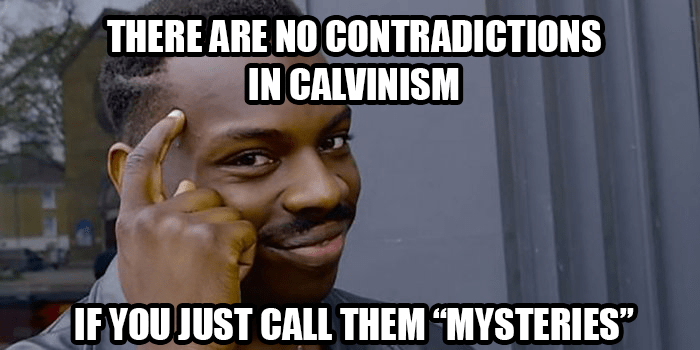
Before going over the thirty problems that theistic determinism creates, let me begin with a simple story that clearly illustrates what is inescapably implied by the teaching. Calvinism, at least the full, five-point version that most of its adherents believe, can be described in a brief illustration which begins with a man I´ll refer to by the name of “Cal.”
Cal owns a large apartment building of about twenty units which he designed and had built some years ago. He rents out all twenty units to different families made up of men, women, boys, and girls.
One fateful day, Cal decides to execute a plan that he designed well before the building’s construction. The goal is to make himself into a hero. So, one fateful dark night at 2 am, as all the people in his building are soundly asleep, Cal, who can control all the door locks in his unit from his remote, with the push of a button programs all the 20 locks in his apartments so that they lock and open from the outside only. And of course, only Cal has the key to each unit. Then, he personally douses the whole building with gasoline and then lights fires in several strategic places, intently watching as the flames quickly engulf the entire structure. As people inside each unit begin to awake to the sounds and smell of flames and smoke, Cal begins to carry out the most important part of his plan. He has chosen to save the inhabitants of only four units of the twenty total. For reasons that only Cal knows, he elects to save unit 3, unit 8, unit 12, and unit 18. For them only will he unlock the doors, allowing escape during the raging fire. He quickly unlocks and opens the doors for only those select tenants who are trapped inside. He shouts, “Fire!” as he opens each door and helps the terrified people flee to safety. Shortly after, the building becomes an inferno and is completely consumed in a matter of minutes, but not before the piercing screams of the dying in the other 16 units finally go silent.
Horrifically, a great majority of the men, women, and children in the building are incinerated into ashes. After the ordeal is over, Cal reveals to those that he helped escape that he is actually the one who programmed the locks, sprinkled the gasoline, lit the fire, and opened only four of the twenty apartments in the building! The shocked surviving tenants can hardly believe their ears as he tells them that he did it all “for his glory,” and to become a hero to them. Now I ask, what should the reaction of those people be?

This story in a very straightforward way details the implications of this terribly errant theology called divine determinism or Calvinism. It is a theology that says that, “All lives do not matter.” I can hear some Calvinist readers mentally shouting right now, “that isn’t true! You just don’t understand Calvinism!” To them I would ask, “Could you please explain exactly how I am misrepresenting it?” What part of my story is untrue? Actually, it is because I understand it so well after many years of study that I am writing these words you are reading right now. I am totally sure as well that all former Calvinists, some who were pastors, seminary professors, and Bible scholars that also once held the belief will testify to the fact that this story absolutely and correctly demonstrates the implications of Calvinistic doctrine.
As already mentioned, the two responses Calvinists most often use when hopelessly cornered are, “It’s a mystery,” or “you just don’t understand the doctrines of grace.” Mmm…It’s perplexing why God would make something so important to be so difficult to understand for the majority of us Christians in the world. If God decrees all things that happen, good and evil, as most Calvinists believe, then God must have simply determined that most of us Christ followers during history and alive on the Earth today fail to understand it, because I am not about to call “Cal” a hero for what he did that dreadful night, nor am I about to believe in a god that decrees all people to sin, then withholds from the great majority the grace to repent, believe and be saved, and then finally holds them completely responsible for that which they could not avoid. Simply stated, this is not the God presented in Holy Scripture and it is because of my desire to see Him glorified that I refuse to believe or teach such a horrendous doctrine.
All adherents to Calvinism, whether it be the modified or hyper version, must admit that their theology paints a picture of a god that plays both sides of the cosmic chessboard- a god that ordains and decrees both good and evil. It should be noted that a theology that makes God the author of evil is heretical at best, and blasphemous at worst. It maligns the holy, and righteous nature of a loving Creator and turns Him into the sadistic puppet master, the beings created in His image to basically nothing but programmable robots, and the universe itself into a twisted, but divine version of the popular sci-fi flick, the Matrix.
Maybe you can begin to see the very difficult and impossible to comprehend implications of this theology of fatalistic determinism. But this is just the beginning. Here are the 30, yes THIRTY reasons why this teaching is false, unbiblical, and even dangerous…
1. The Bible Context problem
Quite simply, the biggest obstacle that the doctrine of Calvinism faces is nothing less than a simple and clear reading of the Bible itself. If only the elect are saved and go to Heaven through God’s predetermined decree and all others are lost forever because they have also been decreed to this fate, then how do we account for the abundant declarations in God’s inerrant word that He…?
…wants ALL men to be saved and come to the knowledge of truth…the man Christ Jesus; who gave himself a ransom for all. (I Timothy 2:4)
And how about the Apostle Peter’s declaration that…
The Lord…is longsuffering to us-ward, not willing that any should perish, but that all should come to repentance. II Peter 3:9
Regarding this verse in particular, we must ask this question to our Calvinist friends:
“If it is true that before a person can respond to God, God must irresistibly cause that person’s regeneration, why is God long-suffering, not willing that any should perish? What is He waiting for? Is God long-suffering with Himself, as He waits for Himself to irresistibly and unfailingly bend the human will to faith and conversion? Isn’t it incoherent to believe that God would actively withhold the grace that man needs in order to respond to the Gospel, while at the same time be long-suffering toward mankind, not willing that any should perish? As an aside, the verse in question states that God is long-suffering “to us-ward”. Doesn’t this imply that salvation is tied at least in some measure to our response?
A very good question for theistic determinists indeed. But let us continue with more of the clear verses that will not let this errant theology be true, such as Ezequiel 33:11, where God declares…
As I live, saith the Lord God, I have no pleasure in the death of the wicked; but that the wicked turn from his way and live: turn ye, turn ye from your evil ways; for why will ye die, O house of Israel?
Such a declaration directly from the mouth of God makes no sense whatsoever if the “wicked” are already predetermined by Him to not repent, but die lost and go to Hell. Or the verse…
He is the propitiation for our sins, and not for ours only, but for the sins of the world. I John 2:2
Does the term “sins of the world” mean the sins of every person? Obviously yes, because of the phrase “not for ours only” (those that are currently saved) but for the sins of the world (those that are not) makes this clear. If Calvinism were true, shouldn’t it only say, for ours alone, the elect? Why would God use such language unless he meant exactly what He said? Such as the verse…
And the angel said unto them, Fear not: for, behold, I bring you good tidings of great joy, which shall be to all people. For unto you is born this day in the city of David a Saviour, which is Christ the Lord. Luke 2:10-12
How can they be “good tidings of great joy, which shall be to ALL people,” unless this good news was meant for ALL people? Is there any other way for God to tell us that He desires all people to be saved? If words mean anything, the answer is no.
And what of Christs’ declarations…
Even so it is not the will of your Father which is in heaven, that one of these little ones should perish. (Matthew 18:14)
Or when he wept over the inhabitants of Jerusalem, knowing of the coming destruction and crying…
“How often I have longed to gather your children together, even as a hen gathers her chicks under her wings, and you were not willing.” (Matthew 23:37)
The parallel verse in Luke 19:42 reads,
“If thou hadst known, even thou, at least in this thy day, the things which belong unto thy peace! but now they are hid from thine eyes.”
It sounds a whole lot like Jesus is saying to them that, “it didn’t have to be this way!” There is no blame to be found but in those that were willfully disobedient and rejected His grace.
We find similar verses in the Old Testament when God sadly proclaims …
“O that thou hadst hearkened to my commandments! then had thy peace been as a river, and thy righteousness as the waves of the sea.” Isaiah 48:18
or..
I have stretched out My hands all day long to a rebellious people, who walk in a way that is not good, According to their own thoughts; A people who provoke Me to anger continually to My face. Isaiah 65:2,3
Why would God say that He is stretching his hands out all day long to these rebellious ones unless He was wanting them to repent and turn to Him? Would He really say this to those that He already predetermined to be disobedient and reject Him? These, and many others verses similar to them convey the understanding that God fervently desired the people to be obedient and experience peace, but they rejected this peace through their own willful disobedience.
Yes, the Bible is clear that God is willing to save all, but not all are willing to be saved, such as in the verse…
…but the Pharisees and the lawyers rejected the purpose of God for themselves, not having been baptized by him. Luke 7:30
These verses were meant to be taken at face value and to say otherwise is to do violence to the text and the rules of proper Bible hermeneutics. The conclusion taken from them is that God desires to save all, and wills that none perish. They declare that God had a plan of peace that belonged to all people, but they rejected it. God was willing, but they were not, hence the reason for their destruction and condemnation is not because of an eternal decree from God, but because of their own rebellion and rejection of his salvation. Yes, these lost ones were responsible before God in every sense of the word, because, once again, it didn’t have to be that way! The fact that God foreknew the choices and decisions in no way means that he decreed them or desired them to be so.
God foreknew the rebellion of man, but even so the Bible states in Genesis 6…
And God saw that the wickedness of man was great in the earth, and that every imagination of the thoughts of his heart was only evil continually. And it repented the Lord that he had made man on the earth, and it grieved him at his heart.
Such passages reveal that God, in His sovereignty, has given mankind and angels the precious gift of free moral agency that can be used in a grievous way, even to the point that He is greatly grieved when this gift is misused.
The most powerful witness against the erroneous doctrine of Calvinism is no less than a simple but straightforward reading of the Bible itself. After reading some of the above verses, we are compelled to ask the questions:
“Does the word all really mean all? Does the word any really mean any?”
Calvinism, in order to make square pegs fit into round holes, is obligated to change the clear and contextual meaning of the very simplest of words and give them another meaning altogether. Its adherents often use the same vocabulary as Free-Will Provisionists, but with a very different dictionary. If the foremost rule in proper Bible hermeneutics is to interpret words in the most literal sense according to context, then the context of the above verses can only mean “all really does mean all, and, any really does mean any.” To say, as the theistic determinist does when attempting to rescue his theology from the clear abrogation these passages bring, that they are only referring to “all kinds of men” or “any of the elect” is to do violence to the clear, contextual meaning of the words and applies a hermeneutic that would make even a Jehovah’s Witness blush. If one must write long arguments and even entire books to explain why a verse doesn’t really mean what it appears to be saying at face value, then there must be a problem with that conclusion. There is absolutely nothing in the passage to indicate that the Holy Spirit, though the pen of the apostle, was only referring to all kinds of men. The context demands that the word be understood in its clearest and simplest form. If God meant to say all kinds of men, he would have inspired the apostle to include the word “kinds.” But in order to twist the context and save their doctrine from the clear contradiction that these verses bring, determinists must insert the word where it is not merited. This is dishonest and is not sound hermeneutics or exegesis. In reality, no twists and turns or hermeneutical gymnastics are required. In this context, all means all. Any means any. Amen, end of story, full stop. Let’s go home. Ah, but there’s more…much, much, more.
The most well known verse in the entire Bible, John 3:16 says as you probably know by heart…
For God so loved the world, that He gave his only begotten son, that whosoever believes in him, should not perish, but have everlasting life.
Who is “the world” in this verse but every person in the world? That is the definition of the Greek word, “Kosmos,” translated “world,” which implies entirety without exception. And who can escape perishing and have eternal life according to the verse? The answer: Whosoever believes in him. Once again, the intention of our Lord Jesus Christ in declaring these immortal words was to communicate the idea that God loves all, and that salvation is potentially for all. To interpret the verse in any other way does violence to the context. But, Calvinists must reinterpret the verse to say…
”For God so loved the elect, that He gave his only begotten son, so that whosoever is elect, will not perish, but have everlasting life.”
Sorry Mr. Calvinist, but such an interpretation is simply not what this verse says, but I understand that you are obligated to interpret it that way in order to explain and defend your premise from the clear abrogation of John 3:16 and so many other verses. Can you begin to understand why all Christianity during the first four centuries, and the great majority of Christians alive today believe the simple and clear message beautifully conveyed by this most well known of all Bible verses?
With clear texts like these, the burden of evidence is on the Calvinist to prove his theology, not on those of us that simply take these verses exactly as they read. Calvinists may shout, “Romans 9! Romans 9!” all day long, but the starting point is not there, but here in the above verses that I have listed. (More regarding Romans 9 will follow) This reason alone should be enough to bring an end to our discussion, but there are 29 other loaded guns for Calvinists to deal with below. Let’s move on to the second one.
2. The “Final Question” problem.
At the final judgment, would not all of the eternally condemned people have a valid point if they asked God, right before being cast into the Lake of Fire:
“Uh…God, before we are cast into the fire, we have just one question…How can you damn us for all eternity if we were not even able to repent and believe in the Savior? You withheld from us the necessary grace that makes regeneration, faith, and salvation even possible. God, are we missing something here? We are now going to the place of eternal punishment simply because you chose to not regenerate us when we were dead in trespasses and sins, and you could have done so! Almighty One, with all due respect, what else could we have done except what you decreed us to do? Because of our absolute depravity, we had no other option because we could only choose that which was evil and against you. It could not be avoided because that is what You determined. And now we are lost…forever! Before we depart from you into eternal suffering, could you please answer just this one question so at least we will know why it is our fault and not yours that we will be tormented throughout eternity?”
I must ask here, just how would a loving, righteous, and merciful God answer their question if Calvinism were true. Calvinist, I´m waiting…
I wrote the following poem about this quandary. Please read it outloud for the full effect.
An Ode to Calvinism from a non-elect entering Hell

It’s a cruel theology
God loves some, but not me.
His grace is not for all I learned,
I´m just a vessel to be burned
Now here I am, forever lost,
Christ refused to pay my cost
Far before all time began,
God decreed I would be damned
He chose from me to withhold,
the grace that could have saved my soul
God, how could I have changed my mind?
if You first decreed me blind?
Oh, why did You elect so few?
And passed by me- what could I do?
You told us “love your enemy!”
but then denied the remedy
That could have saved me from my sin,
and changed my nature from within
A blind corpse, am but I,
predestined to believe a lie
Just does not seem quite right,
a God of love, joy and might
Would by His sovereign decree,
doom me from and for eternity.
It seems wrong to cast me off,
for doing things I could not stop
If I hate, your name I curse,
it´s because You hated me first
And now I must go into Hell,
my destiny You did foretell
My friend, how true is this song…
unless… John Calvin got it wrong?
What? God by my death glorified?
How can it be? unless…they lied!
So, stop and ask, could it be?
God wants ALL saved- yes, you and me!
It´s clear his blood was shed for all,
and to the whole world goes His call
You can be saved! Believe today,
that Jesus Christ is the Way!
His great offer is for you still,
extended to “whosoever will!”
Take of the water that gives life,
that brings an end to fear and strife
Come to the Savior, He’s the Door,
yes, there’s room for yet one more!
So, if you´re lost, you´re to blame!
Not God’s fault, His love´s the same
To all of lost humanity,
there’s grace for you, just come and see!
This poem I believe powerfully shows the absolute fallacy of Calvinism and provokes the honest question: “Why will the lost end up in Hell?” The answer according to Calvinism is not because of a personal choice or even because of sin since those being condemned could do no other but sin. The answer is ultimately because God chose to withhold from them that very grace that could have brought them to repentance and saving faith. Therefore, far from desiring their salvation, God has forever decreed and determined them to be cast into the Lake of Fire for all eternity. Anyone can see the blaring problem such a theology poses. Calvinism, far from glorifying God, does the very opposite and instead slanders his holy, just, and loving character. It is for the very glory of God that Provisionists wage their war against the slander that Calvinism casts upon a perfect God of love, truth, and mercy.
Why not just believe what the Bible says; that the condemned will be lost forever because they hardened their hearts and freely chose to resist the Holy Spirit and reject the Gospel of Christ, their only remedy for the sin that justly condemns them? Once again, their condemnation is great because it didn’t have to be that way! God wanted to save them as I have already shown in the previous points. They have no one to blame but themselves. Yes, Free-Will Provisionism makes the unrepentant sinner truly responsible for his condemnation in a way that Calvinism simply cannot.
3. The Foundation problem
The foundation of Calvinism, or theistic determinism is first built upon a premise, not Scripture. Oh sure, Scriptures are employed in attempting to prove the conclusion, but at the cost of the general thrust and direction of the whole Bible from Genesis to Revelation as pointed out already.
What the Calvinist does is approach the Bible with the pre-conceived belief of determinism, which causes him to read the Bible through the biased, tinted glasses that such a belief system requires. This is why every verse must be interpreted to accomodate the already established premise, instead of allowing the Bible itself to create the premise. If someone wants to see red, even though it´s blue, he can see red if the glasses are tainted enough.
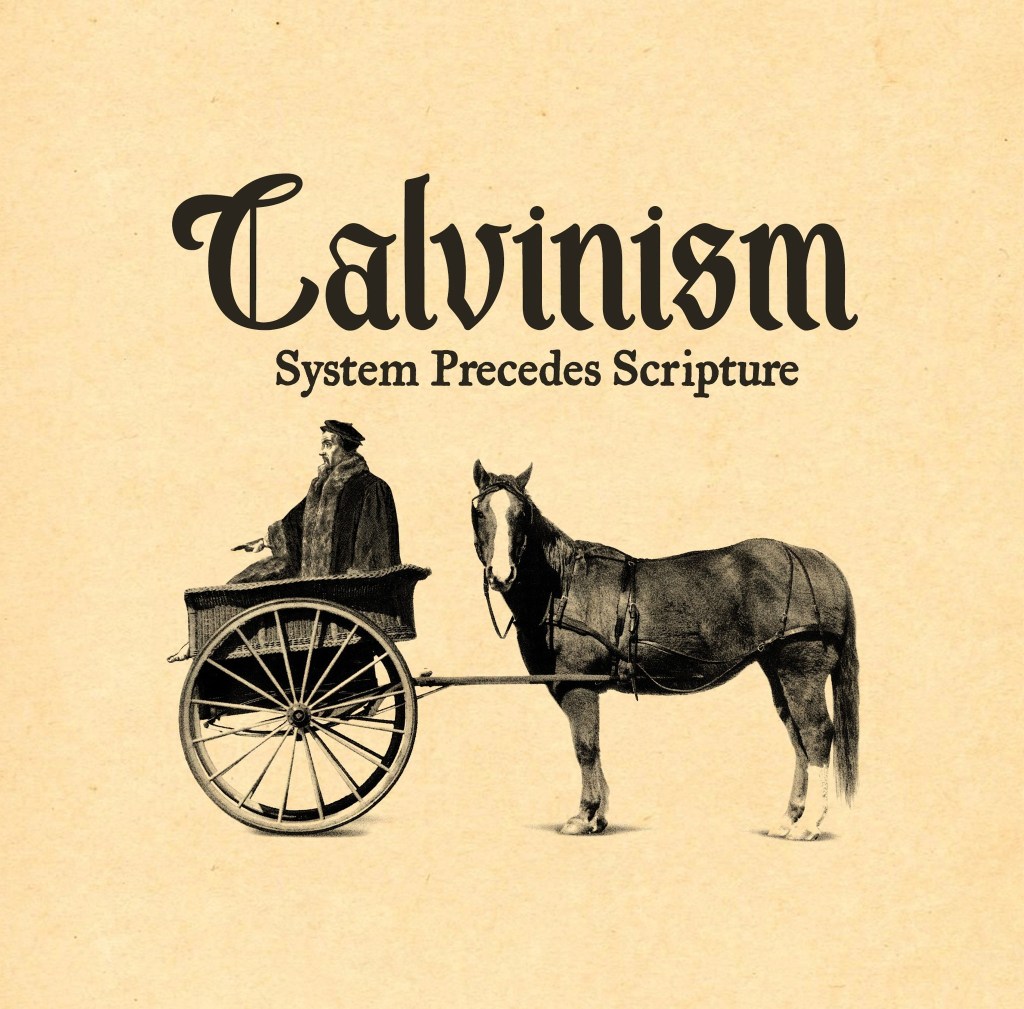
The doctrines of grace as defined commonly by the acronym TULIP are all derived from the premise that everything that happens, be it good or evil, was willed, decreed, and caused by God. This is a misunderstanding of Ephesians 1:11, which has become the “pearl of great price” for Calvinism and the rule by which all the rest of the Bible is subjected. If this premise were true, I would agree with the Calvinist because the teachings of TULIP follow a natural conclusion in the chain of logic even to the point where the hyper-Calvinist criticizes the moderate Calvinist for not strictly holding to all five of them. In this I will agree with the hyper-Calvinist, for once you go down the road of theistic determinism, it only leads to one destination and one conclusion. As even they say themselves, “there is no modified Calvinism, only misunderstood Calvinism.”
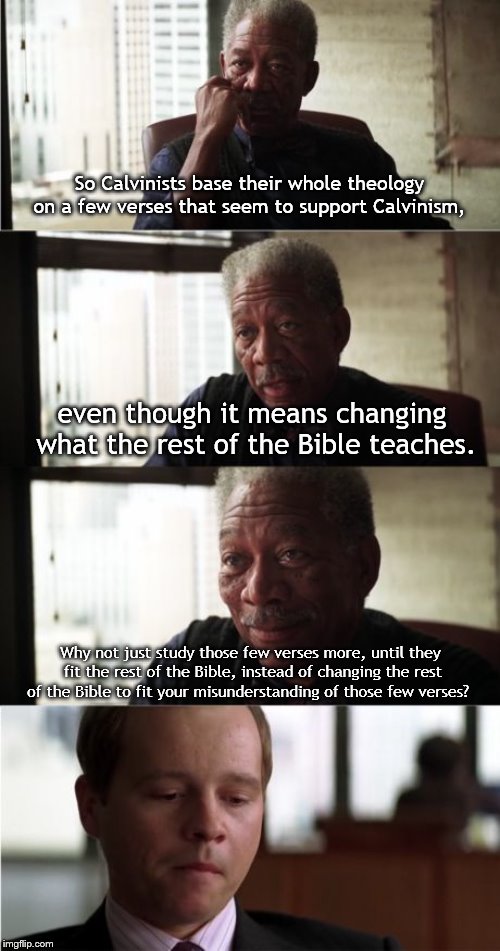
But the question here is if these conclusions were exegeted from Holy Scripture, or if they were the result of a philosophical premise, and then attempted to be forced into Scripture to prove the premise. The answer is the latter. Calvinism is a doctrine seeking a proof text, not the exegesis of a the whole text that leads to doctrinal understanding. This error is similar to what cults practice by swallowing a whole system and interpreting every other scripture, reasoning, or argument by that system. I have noticed that Calvinists, Jehovah’s Witnesses, Seventh-day Adventists, Mormons, (the list goes on), live by something we can call “the worship of passage.” They take a passage from scripture, believe they have found “the pearl of great price” (to prove their premise) and make it the center of their worship. In doing so, they offer up as a sacrifice, the rest of the Bible, in order to make this sacrifice “pleasing to god”. This “sacrifice” becomes the “cornerstone” for their salvation and whole belief system.
But far from building a soteriology from the foundation of a premise or one verse, Free-Will Provisionism draws deeply from the well of the entire 66 books that form the word of God from Genesis to Revelation. We don’t have to seek a few proof texts to try and prove our premise. No, the overwhelming testimony of the Bible itself, which declares the truths of free grace, free will, and God’s love and provision for all are in themselves our premise. Our foundation is the Scripture itself, not the “shiny new toy.” No wonder the doctrine of theistic determinism was completely unknown to early Christianity until the Roman Catholic theologian St. Augustine began to expound it in his debates with Pelagius in the 5th century AD. More on Mr. Augustine later. Let’s move to number 4.
4. The Implication problem
If the saved are discriminately predestined by God unto salvation through no choice of theirs, then the only natural and logical conclusion is that the unsaved were not elected to the same, glorious fate. As a matter of fact, according to John Calvin himself, the unsaved were indeed elected, but not unto eternal life, but unto eternal condemnation. This “double predestination” of the French reformer is sometimes known by its latin term: “le decretum horrible.” Hear the chilling words of Calvin himself:
“God arranges all things by his sovereign counsel, in such a way that individuals are born, who are doomed from the womb to certain death, and are to glorify him by their destruction.” John Calvin, Institutes of the Christian Religion
Doomed from the womb? Glorify God by their destruction? In reality, such a bizarre teaching makes God even worse than the “Cal” in my story above, because at least the suffering that Cal plotted was temporal, not eternal. The doctrine of Calvinism says, incredibly, that God has decreed and elected most of humanity to suffer forever in the fires of Hell. Another fellow Provisionist objected to the teaching by saying…
“I object to Calvinism that God purposely predestines many to be eternally damned for His own glory and pleasure, thus contradicting what the Bible states that God has no pleasure in the death of the wicked (Ezekiel. 18:23). It goes against all sensibilities to imagine that God would eternally condemn persons, who He intentionally created to be unable to respond to His command to repent, and He did so for His own pleasure. Such a doctrine is revolting and pictures a monstrous Being who would actually create persons for the sole purpose of condemning them to hell. But that is the God of Calvinism, while the God of the Bible takes no pleasure in the death of those who do not turn to Him to live.”
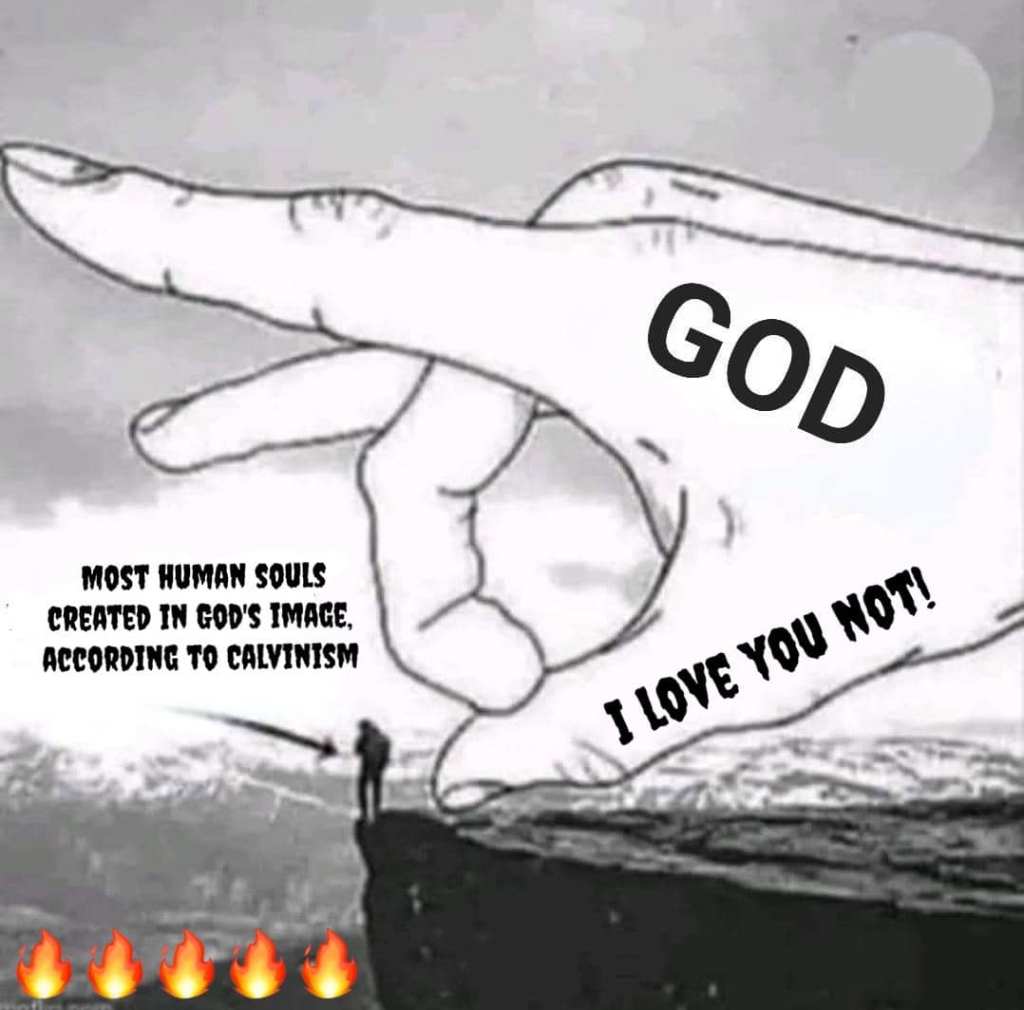
In a nutshell, Calvinism teaches that a person will be saved or damned for all eternity…because,…they were saved or damned from all eternity! Such a teaching is nothing short of blasphemous and is a slander on the holy, loving character of the Almighty. But this is what Calvinism implies, and there is no escape from this conclusion. As the pious soul winner and disciple maker John Wesley so elegantly protested: “Show me an election that does not imply reprobation and I will gladly embrace it.” I will go on record and also agree with Mr. Wesley, that I will joyfully embrace unconditional election if somehow the implication and conclusion is not that those that are lost were simply passed over by God or even worse, condemned to Hell by his eternal decree. But this is impossible. The implication will always be that…
…if the saved are going to Heaven because they were elected, then the lost are going to Hell because they were not.
There is no way around this conclusion.
No matter how you try to add it, two plus two equals four, and it can be nothing else. To say that God is solely responsible for me going to Heaven, but in the same breath say that He is not responsible for the lost going to Hell is once again squaring circles and circling squares. You simply cannot believe in unconditional election without also embracing unconditional reprobation. There is no way around this for the Calvinist and is a quandary for which there is no remedy .

5. The Responsibility problem
Since the lost, unelected majority are completely unable to accept Christ unless compelled to do so through God´s “irresistible grace,” they therefore cannot be viewed as personally responsible for their sin and disobedience since they, because of their total depravity, are in no way able to respond, think, or choose in any other way except against God. They can no more choose Christ then could the condemned tenants open their locked doors in my story, a door that had been locked from the outside by the very one who chose to save just a few. Therefore, with this total inability established, holding them responsible and condemning them would be worse than viciously whipping a five-year-old for not being able to stack hundred-pound bags of cement or shooting a horse because it naturally wants to eat grass. It would be like hating water because it is wet, or fire because it is hot. Why be wrathful and eternally punish someone for something he/she has absolutely no ability to change? How terrible. This is not what the Bible teaches.
But the true reason for their condemnation can be summarized by this one verse…
And with all deceivableness of unrighteousness in them that perish; because they received not the love of the truth, that they might be saved. And for this cause God shall send them strong delusion, that they should believe a lie: That they all might be damned who believed not the truth, but had pleasure in unrighteousness. II Thess. 2:10-12
I am impacted by the phrase that they might be saved in the passage above. Salvation was indeed available to them. God wanted to save them, but Holy Scripture is clear in this verse and many others that God condemns unrepentant sinners because they reject the Gospel of salvation of their own free volition. His wrath is poured out against all evil, and He holds people personally and eternally responsible for choosing rebellion against Him and rejecting His grace. This is the point that the Bible drives home from Genesis to Revelation as even most Calvinists must admit.
But the question must be asked again, “Why would God eternally condemn those that could not possibly choose any other path?” The answer: He doesn’t, because they are responsible before Him and are able to choose their eternal destiny. Yes, they are indeed respons-Able. This is why the teaching of free will makes man far more guilty before God and deserving of punishment than does the soteriology of theistic determinism. (I’ll discuss the Calvinist doctrine of total depravity in more depth below)
Determinists attempt to reconcile this great contradiction by claiming that condemned, unelected people do have free will, because they are choosing what they personally desire in their rebellion against God. They call this compatiblism. The problem with this argument is that, by default, no other choice is allowed to them since God has chosen to withhold from them the regenerating grace that could give them any other option. It’s comparable to saying that there were free elections in Cuba, however the only name on the ballot was Fidel Castro. When no other option is allowed, that is not the definition of libertarian free will, but that of forceful coercion. Free will means that there is more than one option to choose from. After all, didn’t Adam, Eve, Lucifer and a third of all the angels have the choice to obey or disobey? Or were they all, even with a perfect and sinless nature, destined to resist, rebel and fall away from God? How can God be called morally “good” if He condemns people for what He himself ordained them to do, and for what they themselves could not avoid? How can sinners be considered responsible if they were not able to believe and repent simply because God chose to withhold from them the only regenerating grace that could save them? A very difficult question for the Calvinist to answer.
These are just four of the inescapable implications of the doctrine of determinism. Let us look at some more…
6. The Love, Compassion, and Mercy problem
The Bible teaches that only God is truly good. This means that He is just, merciful, true, holy and pure in a way that far transcends anything that man could ever be by himself. Since God Himself is the standard, rule and compass of what can truly be defined as “good,” to teach that God created a great majority of human beings only to condemn them “for his glory” is a direct contradiction to this standard. To create rational, living beings for the purpose of condemning them to an eternity of suffering would be an evil that far surpasses anything that humanity has ever seen on Earth, and if God is truly the moral standard for what men and women can define as good, then this moral standard would fall far below any human concept of goodness and therefore cannot be that standard.
The truth is that God is not glorified in the eternal condemnation of souls, but, quiet on the contrary, He is glorified in the fact that He sacrificed Himself unto death to save souls for eternity! Indeed, God is not glorified at the expense of his creation, but is glorified in his amazing sacrifice of love to redeem it! Such love is what should touch our heart and lead us to worship our Creator, Sustainer, and Redeemer. This is what brings Him glory, not the condemnation of people that had no other option than to reject the Gospel of salvation.
Even finite and sinful human beings have a certain inner concept of goodness, and I know of no one that has not already been brainwashed by the twisted logic of Calvinism that would ever say that the doctrine of reprobation (that God predetermined most people to be condemned for eternity) reflects God’s “goodness” in any way whatsoever.
The very worst implication of the doctrine of theistic determinism is the way that it terribly misrepresents the nature and character of a perfect, holy and loving God. Following the logic, if God chose so few to salvation (comparatively speaking, Jesus said the way to life was “narrow” and “few there be that find it”) and “reprobated” the great majority to perish in their sins and be condemned to Hell forever by purposely withholding from them the grace that could cause them to believe and repent, then God, by default, would be nothing less than a merciless and cruel puppet master- worse than the most evil tyrant in human history. While possessing the power and ability to regenerate all unto saving faith, He chooses a small number, leaving the rest in their inability, depravity and damnation. Is this the God of righteousness, mercy, and love that the Bible portrays? If it is, then we must ask… “What Love Is This?” (See the excellent book by this name written by Dave Hunt, one the best critiques of Calvinism´s misrepresentation of God ever written.) This is certainly not the kind of love that any needy person could honestly relate to.
God´s word declares, “We love Him, because He first loved us.” I John 4:19. Calvinism, however, teaches the opposite, that the unelect “hate Him, because He first hated them.” Yes, says this terrible doctrine, God actually hates those He chose to not regenerate in spite of the fact that they could do, nor be anything else except what they are. This does not reflect the goodness or love of the God of Holy Scripture in any way. Try and twist it any way you wish, but that is the cold, hard reality of Reformation theology. It is not love at all, but a backwards and perverted definition of the very concept. After all, love spelled backwards reads E.V.O.L.! and Calvinism´s backwards portrayal of God is exactly that.
We can compare this to a couple of pop culture references. In the popular movie Avengers, Infinity War, the arch villain Thanos declares, “With all six stones I could simply snap my fingers. They would all cease to exist, and I call that…mercy.” If you saw that movie, even if you are a Calvinist, I’m pretty sure you would agree that Thanos was evil, and such a declaration was not mercy, but actually the very opposite, in spite of what he says. However, this example follows a similar logic that the god of Calvinism displays. If God is truly good and merciful, He should not, could not, and would not create living beings for the sole purpose of eternal damnation, and especially not in order to “be glorified.”

Using another illustration from film pop culture, in a well-known kids movie, The Incredibles, we see a similar scenario. The villain Syndrome creates a powerful, destructive robot and sends it to terrorize and destroy a large city. As it begins its terror and destruction, Syndrome suddenly appears and begins to disable the robot he himself invented with a remote control that he holds in his hand. He does this in order to be viewed as the rescuing hero to the onlooking townspeople. That the god of Calvinism would decree people to be evil and then decree the eternal condemnation of most while choosing to save the minority in order to be “glorified” would make him a far worse villain than a Thanos or a Syndrome ever could be.

It is also interesting to note that males are much more likely to enter into Calvinistic thought than are females. The reason behind this is because females, generally, seem to have more of an inherent sense of compassion, nuturing and caring. Many are the stories of Christian women married to men that later become Calvinists and, as much as they wish to be united in all points of faith to their husbands, are simply never able to embrace the idea that God does not love all and that the grace and mercy of Christ are not extended to all. For a Christian that has a keen sense of compassion and justice, be it man or woman, it is most difficult to embrace the idea that God would predetermine most people to sin, then deny them the ability to repent and be regenerated, and then condemn them to eternal fire for what He himself decreed them to do and that they themselves could not avoid. Such a thought is totally contrary to any concept of human compassion or justice. And what of divine compassion and justice? God is more compassionate than us and certainly more just. The Bible declares,
A false balance is an abomination to the Lord: but a just weight is his delight. Proverbs 11:1
For there is no respect of persons with God. Romans 2:11
How do these verses line up with Calvinistic thought? Answer…they don’t.
7. The Goodness Standard problem
That God would command you and I as human beings to be merciful, just, and to love and forgive our enemies, but then He, according to the theology, turns around and does the complete opposite is nothing less than the very definition of hypocrisy, and God is not a hypocrite. God commands me to love all, even the lost. But according to Calvinism, God hates the lost. Why would God command you and me to love someone more than He Himself does? Such would be a hypocrisy that could never be reconciled.
If Jesus’ declaration is true that “only God is truly good,” (Mark 10:18), which, of course, it is, then God alone can only be our standard of righteousness. If He alone is the standard, He can never be or do anything that is below that standard, or He ceases to be the standard.
None but God Himself is our measure of what what humankind can call goodness and perfection. So, having established this truth which is beyond question, even for Calvinists, it would be an astounding contradiction if this standard were to be lowered to the point where even the most evil of men would not dare to approach. If this happens, then God can no longer be our “rule of goodness” and we are simply left in confusion with no model or measurement to define the lines between good and evil.
So if God, who is declared by his own word to be holy, just, pure, righteous, and the very essence of love itself, indeed creates rational beings for the purpose of eternal condemnation and destruction with no hope of redemption, then He would fall below his own standard, as no virtually no man or woman with the slightest concept of love or mercy would ever conceive of doing such a thing. And if they followed the example set by this standard, then villainous fiends such as Hitler and Stalin would be quite justified, appealing to none other than God Himself as justification for their actions. But some may reply, “Oh, but He is God. He can do anything He wants and whatever He does is good simply because He is God, even if it appears evil to us.” Well, if that be the case, that what appears to be evil to us is should really be defined as “good” because it is God that does it, then we have ourselves quite a problem.
This quandary was answered by none other than the greatest apologist of the middle 20th century, C.S. Lewis himself, who declared…
“On the other hand, if God’s moral judgement differs from ours so that our ‘black’ may be His ‘white’, we can mean nothing by calling Him good; for to say ‘God is good’, while asserting that His goodness is wholly other than ours, is really only to say ‘God is we know not what’. And an utterly unknown quality in God cannot give us moral grounds for loving or obeying Him. If He is not (in our sense) ‘good’ we shall obey, if at all, only through fear – and should be equally ready to obey omnipotent Fiend. The doctrine of Total Depravity – when the consequence is drawn that, since we are totally depraved, our idea of good is worth simply nothing – may thus turn Christianity into a form of devil-worship.
– The Problem of Pain, pp. 28 – 29”
A very strong statement indeed, especially the last sentence. This is a major problem for determinists. By condemning from time and eternity the very beings He created for something that they themselves have no power to change is mind boggling to say the least, but then again, Calvinism is mind boggling and turns the universe into the ultimate puppet show and robot convention.
Following the same paradigm that Calvinism presents: that God would “command all men everywhere to repent,” (Acts 17:30) but then withhold from them the very grace needed to obey that command creates yet another inconsistency and contradiction of epic proportions that is simply irreconcilable. As already shown, to say that the saved play no part in their salvation, and yet, that the lost are fully responsible for their condemnation creates a moral and logical contradiction that simply cannot be reconciled without giving oneself over to a logic that accepts two plus two equals five. Again, you simply cannot have it both ways. If man is morally responsible for his sin and rejection of Christ, it is because the other option also exists for him to surrender to God’s call, repent, believe, and be saved! Once again, the only just conclusion is that if man is responsible for rejecting God’s grace, then he is responsible to receive it as well. Here, the Calvinist will usually proclaim, “It’s a mystery!”, to which we must reply, “What you call a mystery, is nothing less than an absolute contradiction.” The God of the Bible does nothing on the basis of hypocrisy and contradiction.
To say that God is unjust and hypocritical is unthinkable, because He is not. But this errant theology makes God just that- a hypocrite. Again, Calvinism affirms Christ’s command to us to love all people, deal justly with them, and even forgive our enemies. But then it declares- incredibly, that God himself does not do so Himself by intentionally creating individuals for the sole purpose condemning them to eternal torment with no possibility of ever being saved. In doing this, God holds man to a higher standard than He Himself adheres to. This cannot be true, for there is no higher standard than God Himself, and He is not, nor ever will be, a hypocrite. He cannot then call us to reflect His image and to be holy as He is holy, because such an example is anything but holy. It is, once again, hypocrisy, and God is not a hypocrite!
The nature of the God of Calvinism is contradictory to the nature of the God of the Bible which states, “God is Love” (I John 4:8). His love is universal as He loves the whole world and all the “whosoevers” in the world (John 3:16). To hold to a theology that God “so loved the world” (meaning everyone) by default disallows the hideous doctrine of Calvinistic reprobation. As another author, Daniel Merrit, expresses,
“I object to Calvinism for it means God decrees that people do what He forbids – He creates people to violate His commandments and then condemns them for violating what He created them to do. There is no contradiction in God’s nature. God’s holiness will not allow Him to violate His own righteous and perfect nature, for to do so renders His holy nature less than holy.”
8. The Glory problem
The motive of this writing is nothing less than the desire to see God glorified through the proclamation of truth. However, even though “Reformed” theology puts much emphasis on the glory of God, the doctrine actually does the opposite and paints the God of the Bible as an unjust tyrant that condemns countless souls to a lost eternity without any hope of salvation just “for his pleasure.” I have already pointed out that God does not have any pleasure in the death or condemnation of the unsaved (Ezequiel 33:11). It also portrays a God who decrees evil, and ordained every wicked work ever committed. Such a teaching, far from glorifying or honoring God, does just the opposite. How can possibly be said that God is honored or glorified in creating the majority of souls for the purpose of eternal destruction, all the while choosing to save relatively few. No, no…a thousand times no! Scripture, reason, and any small sense of justice and compassion will show that God is not glorified by creating untold billions of people for judgment and eternal torment, but quite on the contrary, by the act of giving of Himself unto death for their very salvation! That God loved all and Christ died for all, so that all would be provided a way to escape the eternal judgment that all deserve is what brings true glory to God. I´ll say it once again: the resounding message of the Bible is that God is not glorified at the expense of his creation, but at the expense of Himself for his creation! This is exactly what we see revealed at Calvary´s cross. Indeed, worthy is the Lamb that was slain!
9. The “God is the author of evil problem.”

The foundation of most all Reformed and Calvinistic thought is stated in the Westminster Confession of 1646, which declares that…
“God, from all eternity, did, by the most wise and holy counsel of His own will, freely, and unchangeabley ordain whatsoever comes to pass.” Chapter III, Sec. I
According to the definition, whatsoever does mean whatsoever, both good and evil. Once again, the implications of this statement are horrendous. It means that God did not just permit all sin, murder, rape, and suffering, but actually ordained it directly by divine fiat. Granted, it may be that not every person that calls themselves a Calvinist ascribes to this belief, but most do because it is the natural conclusion of Reformed theology. John Calvin himself taught it and to not embrace it is to part ways with Determinism when every sign along the road is indicating that this is where the belief leads. Just think about what such a declaration is saying about God. It says that God thought of evil, decreed it, ordained it, and that it was brought it into existence by his will. Of course, this completely contradicts the Scripture everywhere. Just one example where it does so is Jeremiah 19:4,5 where God clearly says…
“They have forsaken me, and have estranged this place, and have burned incense in it unto other gods, whom neither they nor their fathers have known, nor the kings of Judah, and have filled this place with the blood of innocents. They have built also the high places of Baal, to burn their sons with fire for burnt offerings unto Baal, which I commanded not, nor spake it, neither came it into my mind.”
According to this verse, God did not command nor speak the iniquity that He describes here. He says it did not even come into his mind. The same conclusion can be affirmed regarding all other evil as well. So, obviously, in spite of what the Westminster Confession may say, not everything was decreed, commanded, or ordained by God, namely sin and evil. This does not mean that God is not sovereign, it simply means that God is powerful enough to allow angels and humans free will and the sin that may come to pass because of it, yet still accomplish his final purpose and plan. In a way, when we truly consider it, Free-will Provisionism makes God even more powerful and glorifies Him much more than does Determinism with its implied marionettes, robots and living computers.
The book of James in the New Testament echoes the verse just presented in Jeremiah when he writes..
“Let no man say when he is tempted, I am tempted of God: for God cannot be tempted with evil, neither tempteth he any man: But every man is tempted, when he is drawn away of his own lust, and enticed. Then when lust hath conceived, it bringeth forth sin: and sin, when it is finished, bringeth forth death. Do not err, my beloved brethren. Every good gift and every perfect gift is from above, and cometh down from the Father of lights, with whom is no variableness, neither shadow of turning.” James 1:13-17
Of a truth, God does not tempt anyone to sin because sin is against His very nature. The verse concludes saying that every good gift is from above and comes down from the Father. Of course, God does allow trials in the life of his children for their eternal good, but this is not to be confused with tempting them to sin. If God decreed “whatsoever comes to pass,” this would include all temptation and even the yielding to it, making God the author of sin and so contradicting the Bible once again. In fact, regarding temptation, the Apostle Paul taught…
No temptation has overtaken you except such as is common to man; but God is faithful, who will not allow you to be tempted beyond what you are able, but with the temptation will also make the way of escape, that you may be able to bear it. I Corinthians 10:13
Mmm… It sounds from what Paul wrote that God wants us to overcome all temptation, even providing a way of escape that we may bear it! That’s what the text says. So the conclusion is that if we fall, it was not God’s will and there is no one responsible for that moral failure but we ourselves. But Calvinist logic requires that God Himself was responsible for the fall of man in the Garden. If this were so, it should not be called the Fall, but the Shove! Isn’t it so much easier to simply believe what the Bible says instead of having to defend a theology that is so indefensible?
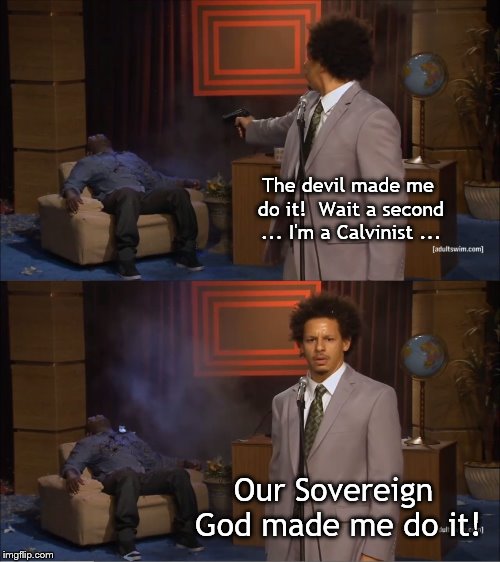
So, if God did indeed “ordain whatsoever comes to pass,” then in reality no one is responsible for anything, for human beings are just puppets in the hand of the puppet master. They are but the moving lips of the doll in the hand of the ventriloquist. If God were indeed responsible for whatsoever comes to pass because He decreed it, then we must add yet another link to the “blame chain” in the Garden of Eden when answering God’s question: “What hast thou done? Didst thou eat of the tree of which I commanded thee not?” The man replies, “the woman you gave me…” The woman replies, “the serpent beguiled me…” But now, according to deterministic Reformed theology, the serpent can astutely reply to God…“YOU ordained me to deceive the woman!” Indeed, according to the doctrine, the excuse can never now be “the devil made me do it,” but “God made me do it.“

Let us think on this a bit and what the implications are. If a Reformed minister that embraces this horrible teaching were truly honest, then when he attempts to console a devastated mother and father after suffering the loss of their son at the hands of a murderer, should say: “Well, at least rest in the fact that God decreed from eternity that your son be murdered in cold blood. The killer was just acting on His orders.” Or, imagine, when he attempts to console a young woman, a victim of rape. Once again, if he were truly honest, then he must say, “Don’t feel too bad dear, this rape was ordained by God to happen. It was His will, and your rapist was just following His plan unknowingly. Why, you should be happy because God´s will was done!” Of course, no Calvinist minister, no matter how hard-core or radical he may be in his theistic determinism would ever say such a thing to a grieving person. But this goes to show just how dishonest they are and just how revolting this doctrine is. If God ordains whatsoever comes to pass, including all evil, how could He ever be trusted or freely loved? How could He be emulated? How could we possibly “be holy as He is holy,” when this teaching makes Him anything but holy?

Perhaps a brief explanation of why evil exists from a libertarian, free-will point of view is merited here. Indeed, a book could be written, and we may not yet be able to answer every question, but here is a one paragraph explanation…
God allows sin and evil because it is by default a possible reaction by the created beings to his authority, law and commandments. This is why angels from Heaven and the first pair were cast out of Paradise. The Almighty has bestowed angels and human beings the gift of free will and the ability to choose to trust and obey Him…or not. In order to freely choose good, the other option must also be available, which is to reject God and embrace evil. So, Lucifer had a choice. Adam had a choice. Cain had a choice. You and I have a choice. If God only allowed the right choice, and not the wrong one, then these beings created in his image are nothing but mere automations with divine “AI” downloaded into them. Again, this would be no different than the marionette controlled by the hand that manipulates its strings, or a computer that can only show on its monitor what has been programed into it. This would then not be love and would be against the very nature of God who is Himself the true manifestation of the very word. Moreover, if God always interfered with the choice to rebel against Him, (what we call “sin”), then we would never fully observe the final consequences of these acts, which are always suffering and death. It is because we understand that the consequences of sin always lead to suffering and death, that we will not choose to rebel against God in the Kingdom of Heaven. In this way, God allowing us to see these terrible consequences, and even suffer affliction at times because of them, indeed “worketh for us a far more exceeding and eternal weight of glory.” II Cor. 4:17
As already mentioned, God does not decree us sin, but He does desire us to see the results of the terrible things that happen when we choose to disobey Him. Why? So that in eternity the “sin and rebellion issue” will not happen again. It is our “light affliction, which is but for a moment.” This is the reason why He allows us to continue living in this world of sin and suffering. But the day is coming when He will finally say, “enough!” But until that appointed day, He is preparing a people for Himself and for eternity. “For him He foreknew, He also predestined to be conformed to the image of his Son.” Rom 8:29. This verse, which is one of the the go-to proof texts of Calvinism, actually teaches that God’s purpose is so much more than taking people to Heaven. It is to conform them to the image of his son. I will discuss more about this passage a bit later.
Of course, not every question of “why did this happen?” can be clearly answered or understood in this life. God used four whole chapters in His reply to Job but never did explain “the why” such terrible things befell him. God does however, ask us to trust Him and keep an eternal perspective. Perhaps one day we will understand the “why” behind everything, but in the meantime, may Jesus Christ be our wisdom. (1 Cor. 1:30) Sometimes, as the old song goes, “you don’t need to understand, you just have to hold his hand.” Let us remember, He reveals his truth to His humble children, and not always to the mighty and learned. There is much more than can be written here regarding this subject, but let this suffice for now as we move on the the next major problem that Calvinism presents.
10. The Hidden Deception Problem
Once again, far from demonstrating to the world the loving and just nature of God, Calvinism presents a god that is unjust and completely hypocritical: a classic example of “do what I say, not what I do.” We have already discussed the hypocrite problem, which leads to a a moral inconsistency of epic proportions that must be hidden by the proponents of Calvinism and only serves to confuse and repel people from Christianity. It is hard to evangelize the lost while presenting such a god to them. Unless, of course, you decide to not tell them and make them assume that God loves everyone and wants to save every person as the Bible implies. But, for the determinist, this would be dishonest, would it not? Perhaps this is why the Calvinists that actually take the time to evangelize the lost are careful to keep everything they believe under wraps while speaking to unbelievers about salvation. As a matter of fact, most Reformed preachers sound a whole lot like Free-Will preachers when they share the Gospel! But this is nothing but a deception. Hiding what you truly believe from the people you are attempting to reach is not good policy and is practiced by many heretical groups. This is why sects such as Mormons and Seventh-day Adventists are not transparent from the beginning with possible converts regarding all that they believe, simply because they have much to hide and know that the person will flee if they were given the “whole deal” up front. If you must hide what you believe, then maybe you shouldn’t believe it! I, for one, am not willing to do so. I´ll lay all my cards on the table from day one when sharing the good news to someone. Provisionist theology has no need of hiding anything at any point. Truth and transparency are always the best policy.
Let me give an example of this hidden deception. Imagine a Calvinist getting together a random group of about thirty children, attracting them with games and ice cream. When he has them all in a circle, listening intently, he tells them,
“Now kids, God probably loves some of you and decided a very, very long time ago that you will be in Heaven with Him one day. I don´t know which of you will end up there, but I can also tell you that most of you probably won´t because God chose to not save you and also decided a very, very long time ago that you will go to Hell and suffer forever. Once again, I don´t know which of you is predestined for Heaven and which of you is predestined for Hell, I just want to explain how things really are.”
Now I fully admit that no Calvinist or Determinist, no matter how radical he may be, would ever say such a thing to a group of children. But this is not the point. The point is that, according to what was said to the children in this theoretical scenario, nothing in the above dialogue is untrue to the Calvinist. Is there one thing that was said to the children that does not line up with Calvin´s Institutes or the doctrine of divine determinism? No, there is not. So, this being the case, why would you have to hide such a belief from these children? Once again, should we believe a doctrine that we must hide from others? I refuse to do so. This is yet another reason why I could never be a Calvinist.
Continuing with more of the inescapable conclusions of the soteriology of fatalistic determinism…
11. The “Children” problem

Let´s look at the above scenario from another angle as well. If you believe in the doctrine of election as taught by Calvinism, you simply cannot honestly sing the precious Sunday School song:
“Jesus loves the little children, ALL the children of the world. Red and yellow, black and white, they are precious in his sight, Jesus loves the little children of the world.”
And why could you not sing it? Because according to this errant theology, God does not love all the little children of the world in a redemptive sense. In that way he only loves the “elect” ones. He does not desire to save them all. If He truly loved them, He would want them all in Heaven, right? Anything less would not be love. If, by the Calvinistic definition, love simply means “sending the rain on the just and the unjust,” we must ask ourselves yet again, “What kind of love is this?” Certainly not a love that is worth admiring. It would be like feeding a good meal to a man bitten by a deadly viper while withholding from him the antidote that will stop the effects of the lethal venom.
The implications of this doctrine, once again, are horrific. Calvinist parents cannot look upon their newborn child and honestly say “God wants our baby to be saved for all eternity!” Sadly, they are compelled to look at their precious little one and say, “We hope our baby is among the elect.” And how can they know? Sadly, they cannot. Perhaps this helps us understand even more why women, especially mothers, revolt at the thought of Calvinistic election and reprobation. And if that small child dies, they have no way of having the assurance that they will see their child again in Heaven since he/she never came to the age of being able to believe in Christ. Most Calvinists are quick to affirm that true salvation means regeneration which of course, according to them, produces repentance and faith in the Gospel. If this be true, how is a baby or young child ever to be considered “saved?” Some within the Reformed camp, such as conservative Lutherans, have proposed that infant baptism is the solution to this enigma, that all baptized infants are among the elect, but this of course, makes the baptismal ordinance the “means of salvation” instead of faith alone which causes all kinds of theological problems. For this reason they are forced to adhere to the unbiblical practice of infant baptism in order to be consistent to their theology and have any kind of assurance that a young child will go to Heaven and not Hell should he/she die before the age of conscience and reason. Can you see the problems and inconsistencies this creates? Isn´t it much better to simply believe Jesus’ words…?
“Let the little children come unto me, for of such is the Kingdom of Heaven?” Matthew 19:14
And,
“even so it is not the will of my Father in Heaven that one of these little ones should perish.” Matthew 18:14
Yes, I believe so. Part of the enigma that all Reformed theology in general faces when dealing with children is its erroneous understanding of original sin. All true Christians believe that people are born with a sinful nature, but those of the libertarian free-will camp believe that young children live under the prevenient grace of God. In other words, if they die, they go to the presence of Christ in Heaven. This conviction comes from the above declarations of Christ regarding children as well as some of his other statements about sin such as…
“If I had not come and spoken unto them, they had not had sin: but now they have no cloak for their sin.” John 15:22
and…
Jesus said unto them, “If ye were blind, ye should have no sin; but now ye say, ‘We see.’ Therefore your sin remaineth.” John 9:41
These verses and others show that the moral accountability of conscience has much to do with eternal judgment and condemnation. Young children, obviously, are not yet morally accountable for sin, nor are severely mentally handicapped adults, who are also under the prevenient grace of God. We do not believe that human beings are personally guilty of Adam’s sin as many in the Reformed camp teach, but we do believe that the mortal effects and sinful nature are passed on to every human being at conception.
I often wonder how a Calvinistic minister answers the questions of a sobbing mother who asks him if her child who died will be in Heaven. If he is honest and true to his theology, he can only say that nobody knows, for it is impossible to determine if the young child was among the elect. But if percentages have anything to do with it, the answer to the question is should most likely be a cold, cruel… no. How chilling. But this is the conclusion because Calvinism teaches that babies are “vipers in diapers.” Can you imagine holding your newborn son or daughter and exclaiming, “You, little one, are guilty before God because our forefather disobeyed by eating the forbidden fruit and God has attributed that sin to you too! (In spite of the fact that the Bible says over and over that the children will not be punished for the sins of the fathers) Our only hope is that you may be one of the elect that God has chosen to regenerate one day because if you die now, you will be guilty of Adam´s sin, as if you ate that fruit.” Of course, no one would ever actually say this over their child, but it is exactly what most Calvinists believe. Bad theology leads to bad conclusions.
Theistic Determinism creates problematic scenarios even for older children. Imagine a case where Christian parents pray for many years for the salvation of their wayward son or daughter who ends up dying as an adult in their unbelief and rebellion. If Calvinism were true, these pious and godly parents could not attribute the final perdition of their beloved child to his/her own, continual rejection of Christ, but upon God Himself who simply continued to withhold regenerating grace from their son or daughter in spite of their parental pleadings. Once again, how utterly terrible! If such things were true, we must ask, why even pray for our children at all since everything has already been decided? I will tell you why. Because this is NOT the God nor the faith that is portrayed in the Bible. Prayer does change things and can bring about what would have not been without the prayer. Yes, once again, the problems that arise from the doctrine of theistic determinism are many. Too many. Here is yet another big one…
12. The Evangelism problem.
He that believes in divine, discriminatory election cannot truthfully preach the Gospel to a large group of people and proclaim, “God loves every one of you! Yes, you, and you, and you, and you! Christ died for your sins- yes yours. You, yes- you can be saved today if you will but repent and believe the Gospel!” And why can he not preach thus? Because he most likely would be lying to them by preaching such a concept since in reality he believes that God only loves some, has elected only some, therefore only some will be saved, but certainly not all. As a matter of fact, it could be that there is not even one of the elect within the group of lost people he is preaching to. If the Calvinist were honest while preaching to the group, he would be compelled to say: “God might love some of you, but probably not most. It´s possible that Christ died for some of you, but not all. Those that were predestined to salvation will be saved. As a matter of fact, you have no personal choice in the matter since God’s grace is irresistible. If you believe it is because God is irresistibly causing you to believe!”
Again, no Calvinist would ever preach that way, even though that is exactly what they believe, and it’s a pity that they refuse to preach what they truly believe. As I have already pointed out, this is dishonest. I for one, refuse to believe a theology that I could not honestly preach publicly. This is yet another reason why I, and you, must reject this erroneous soteriology.
And also when speaking one-on-one in a personal setting, the Calvinist cannot honestly evangelize an unbeliever and declare, “Friend, God loves you, Christ died for you, God wants you to be saved!” In order to be true to their belief system, he can only say that God might love you, Christ may have died for you and God might want you to be saved, etc. Everything depends simply on one thing: if the person being evangelized happens to be one of the elect or not. Here, once again, we see that the main dynamic in Reformed theology clearly is not Christ dying for the sins of the world, but in answering the question if you, I, or the one we are preaching to happens to be one of the “elect” or not. This is not what Scripture teaches and is certainly not the conclusion we come up with by taking the Bible at face value. By believing simply what the Bible teaches about soteriology, I can honestly tell a person, “friend, God loves you, yes you! He gave his only Son to die for you and wants you to be saved.” What a joy to honestly be able to tell people this wonderful truth! Perhaps this is why a great majority of the people we see preaching in the street and going door to door to share the Good News are not Calvinists, but free-will Provisionists.
It is sad that the Calvinist cannot cannot honestly tell the unsaved that God loves them in a salvific sense, or that He wants them to be saved forever, and that Christ died for them for risk of lying to them because they may not be of the elect. And looking at the other side of the coin, they would be speaking the truth most of the time if they told them, “God doesn´t love you, Christ didn’t die for you, and God does not want you in Heaven with Him forever.” How sad. Thank God I am a Calvinist no longer and I can preach God’s truth as presented in the Bible knowing that I am preaching what I truly believe and deceiving no one.

13. The Invitation problem
The doctrine of discriminatory election turns the Bible´s invitations of “whosoever will” into “I´m choosing just a few,” thereby rendering as completely meaningless the precious offer of salvation to all that is presented so many times in the Bible. Such a theology turns these invitations offered to “whosoever will” into a mockery. Think about it. Does God’s loving invitation to whoever is willing actually mean that it is available only to those that have been forced to accept it through irresistible grace? Such is a double standard, a contradiction of terms, and is not congruent with the perfect, merciful, just, and loving God portrayed in Holy Scripture. It also makes a useless mockery of God’s call for us humans to choose. Consider God’s powerful command to choose in Scripture…
“I call heaven and earth to record this day against you, that I have set before you life and death, blessing and cursing: therefore CHOOSE LIFE, that both thou and thy seed may live: That thou mayest love the Lord thy God, and that thou mayest obey his voice, and that thou mayest cleave unto him: for he is thy life, and the length of thy days.” Deuteronomy 30:19,20
How can God call on man to “choose life,” or “choose this day whom ye will serve,” if his choices were already made by the very one that is commanding him to make that choice? Once again, such a confusing teaching is nothing short of science fiction and makes a mockery of the justice of God and misrepresents his holy and just character.
And what of the beautiful invitation extended to the sinner in the very last chapter of the Bible?
“And the Spirit and the bride say, Come. And let him that heareth say, Come. And let him that is athirst come. And whosoever will, let him take the water of life freely.”
Are we truly supposed to believe that “whosoever will” is really supposed to mean “whosoever is elected and drawn with irresistible grace?” I think not. The term conveys that it is available to all, that all can come, but there is just one condition…you must be willing of your own volition. To teach any other is to do violence to a most beautiful and precious invitation that God chose to put in the very last few verses of His Holy Book.
14. The problem of Evanescent Grace.
Calvinism also struggles to explain how we can observe a person come to Christ, bear good fruit, (sometimes for years) and then eventually fall away from faith permanently. The problem arises in that they believe that the elect will persevere in faith and obedience, but at the same time no one can repent, believe, or show spiritual fruit without the grace of God. So, this produces a very difficult question for Calvinists to answer: What about those that confess Christ, repent of their sin, bear good fruit, walk in obedience for a good while, but later eventually fall away from the faith? Was God just playing with them? Was that really a work of the Holy Spirit? The Calvinist is obligated to say “yes” to the question but then has to explain why God would deal with a person this way only to let him/her be lost at the end. A real dilemma indeed.
I remember in particular a young man who came to Christ in our church where I was pastor some years ago. He completely repented of his previous life of terrible sin. After a few months, he began to evangelize the lost. After a couple of years he even became a spiritual leader. He was solid and was bearing real fruit during those two to three years. All was well until he was introduced to the so-called “doctrines of grace” and eventually fully embraced Calvinism. In spite of my pleadings and appeal to Scripture, he continued in that belief system. More time passed and he became involved in sin again, and little by little, he eventually abandoned his faith in Christ altogether. Today he denies Christ with his lifestyle of sin and is even involved in occultic practices. I must ask, “How do Calvinists explain such cases?” Calvin explained it by yet another hideous teaching that he called evanescent grace. John Calvin writes in his Institutes…
“Experience shows that the reprobate are sometimes affected in a way so similar to the elect that even in their own judgment there is no difference between them. Hence, it is not strange, that by the Apostle a taste of heavenly gifts, and by Christ himself a temporary faith is ascribed to them. Not that they truly perceive the power of spiritual grace and the sure light of faith; but the Lord, the better to convict them, and leave them without excuse, instills into their minds such a sense of goodness as can be felt without the Spirit of adoption…there is a great resemblance and affinity between the elect of God and those who are impressed for a time with a fading faith…Still it is correctly said, that the reprobate believe God to be propitious to them, inasmuch as they accept the gift of reconciliation, though confusedly and without due discernment; not that they are partakers of the same faith or regeneration with the children of God; but because, under a covering of hypocrisy they seem to have a principle of faith in common with them. Nor do I even deny that God illumines their mind to this extent…there is nothing inconsistent in this with the fact of his enlightening some with a present sense of grace, which afterwards proves evanescent.” (Institutes 3.2.11)
In order to be true to the P in the TULIP, which is perseverance of the saints, Calvinists must declare that such a one like the young man in my church was not ever truly converted and was finally lost since the regenerate will always continue in the faith unto the end. This is the clear teaching from the Synods and Calvin’s Institutes. But if such a one was not among the truly elect, how then do we explain the fact that he/she came to faith in Christ, repented, and even bore good spiritual fruit for so long? After all, no one can come to Christ unless the Father draws him, (Jn 6:44) so God’s Spirit must have been working in that person, right? Scripture also declares that “no man calleth Jesus Lord but by the Holy Ghost,” (I Cor 12:3) so I must ask, “did God draw such a one unto Himself only to later cast him/her away afterwards?” This was quite a quandary for Calvin himself, but in an attempt to reconcile the contradiction, this horrific doctrine of evanescent grace was brought forth. This God dishonoring teaching says that the Lord does in fact draw such a person unto Himself, but not to the point of true regeneration and salvation. It’s basically a “close but no cigar” refrain. He draws the sinner by His grace and Spirit only to reject him in the end so that their condemnation may be more complete. How revolting! This could be compared to giving a spoon of water to a man dying from thirst in the desert only to let him perish by denying him the proper amount of life-giving liquid needed to save him. It seems unthinkable that God would do such a thing, but evanescent grace is the only way the conundrum can be explained regarding the believer that returns to his life of sin and unbelief. Once again, we see how the conclusions of Calvinism grossly misrepresent the character of God.
Let me appeal to the Calvinist by asking…
John Calvin taught what is known as ‘evanescent grace’ (Institutes, 3.2.11). Calvin thus taught that God bestows grace on the reprobate (or non-elect) and implants faith in them that is “so similar to the elect” that sometimes, there is virtually “no difference” between the elect and the non-elect. (Emphasis mine but quoted from Institutes.) Calvin further taught that, “In the elect alone he implants the living root of faith, so that they persevere even to the end.” In other words, true saving faith only proves to be truly saving if it perseveres to the very end. In light of this, is it possible for a Calvinist to ever have true assurance of salvation? Doesn’t this doctrine naturally undermine the Biblical markers for assurance? How can someone know that his present faith is genuine, if genuine faith only proves to be genuine if it perseveres to the very end? After all, Calvin taught that the effect of the grace working in the elect and the reprobate can be almost indistinguishable. So, how can a person be sure that the inner witness of the Holy Spirit is not an “inferior operation of the Spirit” which “afterwards proves evanescent,” the “better to convict them,” and “leave them without excuse?” Can a person even have assurance by producing fruit, considering that Calvin taught that the reprobate, through evanescent grace, “may for several years… produce fruit?”
In view of evanescent grace, no believer of Reformed theology can ever have the assurance that he is among the truly elect and will finally be saved, for how does he know that his faith will persevere unto the end? How does he know that he is not simply under the delusion of evanescent grace and only thinks he is among the elect but alas, like so many, he is not? Such a dilemma has caused doubt, anxiety and fear in more of those that ascribe to the “doctrines of grace” than we’ll ever know. Perhaps the theology of deterministic election is not as “sweet” as we once thought it was. What is sweet, however, is the faith that salvation is in Christ alone, in his blood, his righteousness, and his grace. But, our assurance of eternal life is based on the continuance in this faith as the Bible declares, (I Cor 15:2, Col 1:22,23), not on a supposed elective decree that manifests itself in forced faith or forced unbelief.
15. The Starting Point problem: Faith in Christ crucified, or in God´s elective decree?
When you think about it, theistic determinism changes the good news from “Praise God, Christ died for our sins and rose the third day so that whosoever believes in Him should not perish, but have everlasting life,” to…“Praise God, I am one of the elect!” (Or am I?) It puts the very death and resurrection of Christ as subservient to a predestination decree. In Calvinism, Christ is no longer the starting point, emphasis, and cause of man’s salvation, but simply an instrument for carrying out the true origin and cause, which is non other than God’s elective decree. The issue is no longer that of faith and repentance, but of who has been chosen and who has not. Indeed, the “modus operandi” and origin of salvation according to Calvinism is not faith in Christ alone, but in the fact that God has “chosen me in Him before the foundation of the world.” I noticed this myself when I held to the doctrine of individual predestination and was troubled by this because, quite simply, this is not what the Bible teaches anywhere. Our hope, joy, and trust are in Jesus Christ alone, not in an electing decree.
It is interesting to note that for the Provisionist, all men and women are lost and on their way to Hell, and for this reason Christ came and died to redeem them all. However, according to Calvinism, those among the elect were never actually lost, since they were chosen unto salvation from all eternity. There was never a moment when they could truly be called “lost.” As I already mentioned, for them, the determining factor in their salvation is God’s discriminatory choice, not faith in Christ crucified for sins. God’s elective decree is the active agent and foundation, not faith in the Gospel of Christ. Therefore, the natural conclusion for the Calvinist is (subconsciously) that the cross plays a lesser, yet necessary role in order to make salvation efficacious. On the other hand, the free will Provisionist holds to the fact that faith in Christ crucified for sinners alone is the foundation and active agent in man’s salvation, because this is what Scripture clearly teaches.
Granted, there are different versions of Reformed theology, and many Calvinists are fond of saying, “but you just don’t understand Calvinism!” or that “you are misrepresenting it.” I don’t believe I have done that here, but have only presented the purest form of the doctrine as taught by the French reformer in his acclaimed Institutes of the Christian Religion. These are the conclusions that I, and countless others have arrived to, and it is not because we do not understand the doctrine, but because we do understand it. And if, per chance, we are misunderstanding it, the question must be asked why God would make something so important and essential so difficult to understand, even by (as Calvinists will admit) most Christians! A real problem indeed for those that embrace this confusing theology.

We´re far from finished, but halfway there. The problems with Calvinism, Determinism and Reformed Theology continue…
16. The “Robot” problem.
Calvinism implies that mankind’s response towards God and love to Him are forced, coerced, and nothing short of the programing of a computer or robot. Once again, this is not what the Bible teaches. It teaches that God created man in His image, in the Imago Dei. No other creature was made in his image. No other life form beyond humanity and angels have even the faintest concept of deity. And why did God create these special beings that have the amazing capacity to enjoy a relationship with Him? Indeed, I agree with Calvinists that we were created to “glorify God and enjoy Him forever,” but to have and enjoy this relationship is part of this glory.
Holy Scripture tells us that God is love. Notice, it doesn’t say that God is just loving, but that He is love itself. And how is true love defined in Scripture? It is the genuine and free personal desire to seek the eternal good of another, even to the point of self-sacrifice. This is what we observe when God gave of Himself in willingly sending His Son to die in our place. “For God so loved the world, that He gave his only begotten son…” If God’s love is manifested by His free will towards man, wouldn’t man’s response and love to God also be manifested as such, through his free will towards God? That which must be coerced, compelled, forced, or programed cannot be called biblical “love” in any sense of the term. Love must be free or it cannot be love.
This is why my heart rejoiced when my wife agreed to marry me, because she didn’t have to. I knew she loved me and wanted to spend the rest of her life with me by her response to my proposal, which was not coerced in any way, shape, or form. The other option existed too for her, which was to say…no! The fact that she said yes meant she freely chose to spend the rest of her life with me, and it’s a love that exists even today almost thirty years later! Yes, love is a wonderful thing because it is based on nothing less than free will. If my wife were programed like a robot to love me, would that be love? Would my heart rejoice in her the same way? If love comes from any other foundation that is not free will, it is simply not love. Hence, the reason why a “super robot wife” will never be like the real thing, even though with the real thing the possibility exists of rejection, arguments, infidelity, etc. In order for love to exist, the other option must also exist, which is the option to not love. Now, perhaps it is a bit easier to understand why God made beings that were capable of loving Him, or not loving Him. You cannot have one without the possibility of the other. God created man in his image for a relationship. A true relationship can never be just an artificial automation or artificial intelligence. Taking this into account, it’s as easy to understand why a child rejoices more with a real puppy than a plush toy dog, even though the latter does not make messes, chew on fine leather or cost any money to maintain.

17. The “Total Depravity and Regeneration Before Faith” problem
We’re actually combining two problems in one here. The bottom domino in the tower of Reformed theology is the T of the T.U.L.I.P., which is the Calvinistic doctrine of Total Depravity, and if this domino is removed, the whole tower comes crashing down. By “total depravity,” reformed theology actually means “total inability,” namely, that all people are completely incapable of believing in Christ, repenting, or seeking God unless they are first irresistibly regenerated by Him first. In other words, conversion and salvation must occur before faith, not after. Please note, there is not one Bible verse that teaches this, and the zealous Calvinist is forced to rally to the only argument that he can muster, namely that we were “dead in trespasses and sins,” and that “dead people can’t do anything.” That analogy would work if God’s book supported this premise, however the Bible is clear that “being dead” spiritually simply refers to the state of being separated from God and condemned by sin- but not total inability. The prodigal son was described in the parable by the father as “dead” yet we see that he repented and came home to the father. Luke 15:32 The church of Sardis was described thus by Christ: “thou hast a name that thou livest, and art dead.” Rev 3:1 He then in the very next verse adjures them to “watch, strengthen those things that remain, and repent,” a very strange command indeed if by “dead,” he meant total inability. In both these cases, being dead did not mean inability, but separation from God and a lack of true spiritual life. As Christians we are told that we should “consider ourselves dead to sin,” but I have yet to meet a person that believes that this verse means that we are so dead to sin that we are unable to commit sin, which would be the rightful conclusion if being dead meant total inability as the Calvinist declares.
All persons throughout history have proven to be sinful, but we also observe that they are also inherently desirous of filling the deep void and vacuum inside their soul. God created human beings in his image and for Himself, and until these created beings are filled with the presence of their Creator, this void and vacuum will always exist. We observe how Marxist societies have attempted to eradicate God from society and even the minds and consciences of their citizens, only to find that their efforts actually increased the desire of seeking and knowing God among the general population. This is because man, even in his fallen state, was created in the Imago Dei with a conscience of good and evil and a natural, inherent understanding and belief in the Almighty. This to the point that when “the grace of God that brings salvation appears to every man,” (Titus 2:11) they are responsAble to surrender to, or harden their hearts to this precious, heavenly influence. This is what is implied in Romans chapter 1, when the apostle Paul writes,
“For the wrath of God is revealed from heaven against all ungodliness and unrighteousness of men, who hold the truth in unrighteousness; Because that which may be known of God is manifest in them; for God hath shewed it unto them. For the invisible things of him from the creation of the world are clearly seen, being understood by the things that are made, even his eternal power and Godhead; so that they are without excuse: Because that, when they knew God, they glorified him not as God, neither were thankful; but became vain in their imaginations, and their foolish heart was darkened. Professing themselves to be wise, they became fools… Wherefore God also gave them up to uncleanness through the lusts of their own hearts…And even as they did not like to retain God in their knowledge, God gave them over to a reprobate mind, to do those things which are not convenient; Romans 1:18-24, 28
The whole context of the above passage contradicts Calvinism’s definition of total depravity as being total inability. The passage says that God holds man responsible for their rejection of Him, because, once again, it didn’t have to be that way. It is because these people “did not like to retain God in their knowledge” that He “gave them up to a reprobate mind.” If they were already totally depraved from birth, one must ask why God would have to do such a thing, since they were already in such a reprobate, depraved condition. How was “their foolish heart darkened,” if it was already hopelessly dark as the doctrine of total depravity claims? In the very next chapter Paul reiterates the same thought when he says:
“But after thy hardness and impenitent heart treasurest up unto thyself wrath against the day of wrath and revelation of the righteous judgment of God; Who will render to every man according to his deeds: To them who by patient continuance in well doing seek for glory and honour and immortality, eternal life: But unto them that are contentious, and do not obey the truth, but obey unrighteousness, indignation and wrath, tribulation and anguish, upon every soul of man that doeth evil, of the Jew first, and also of the Gentile; But glory, honour, and peace, to every man that worketh good, to the Jew first, and also to the Gentile: For there is no respect of persons with God. For as many as have sinned without law shall also perish without law: and as many as have sinned in the law shall be judged by the law…For when the Gentiles, which have not the law, do by nature the things contained in the law, these, having not the law, are a law unto themselves: Which shew the work of the law written in their hearts, their conscience also bearing witness, and their thoughts the mean while accusing or else excusing one another; in the day when God shall judge the secrets of men by Jesus Christ according to my gospel.” Romans 2:5-16
Once again, the exegesis of the above chapter absolutely negates the Calvinistic concept of total depravity. The context of the passage is unconverted mankind in general, and the Apostle clearly speaks of God holding them accountable, making reference to their hard and impenitent heart. But he also refers to them as “seeking immortality” and the witness of the law in their conscience. These references would make absolutely no sense at all if the term “dead in trespasses and sins,” meant “total and complete inability.” After all, how could God hold someone accountable for something that they had no ability to change, unless of course, they did indeed possess that ability. Romans chapters one and two infer that they do have that ability, so if the Calvinist wants to argue, he need not argue with me, but with the Apostle Paul himself. And just in case the argument were put forth that he is referring to only the un-elect here, the words “for there is no respect of persons with God,” in verse 11 should put an absolute nail in the coffin. If God elected some to eternal life and the majority to eternal damnation, such a verse would be absolutely meaningless and contradictory.
Once again, if we believe that all people are able to respond to God, it makes them truly responsible and guilty before Him should they reject His truth and harden their hearts, and this in a way that the deterministic belief in “inability” could never accomplish. We must here pause for a moment and ask, “if mankind in general is already dead to the point that responding to God from their own free will is an impossibility, why would II Thessalonians 2:10-12 say…?”
“And with all deceivableness of unrighteousness in them that perish; because they received not the love of the truth, that they might be saved. And for this cause God shall send them strong delusion, that they should believe a lie: That they all might be damned who believed not the truth, but had pleasure in unrighteousness.”
Why would God send these people that received not the truth a strong delusion to believe a lie if they were already so depraved that they are unable to believe? Were they not already believing a lie? Must one put a blindfold over the eyes of a dead man? A much better explanation is that these people could have been saved, but had rejected the truth to the point that God finally, as Romans 1:28 states, “Gave them over to a reprobate mind.” God is merciful but his patience does have limits, and when a man rejects God’s influence on a regular basis, his heart becomes hardened. Note, it is man that hardens his own heart in these cases, not God. If people were already so dead and hardened as to be unable to respond to God’s grace, what would be the point of sending them delusion to believe a lie or giving them over to a reprobate mind if they already had a reprobate mind before giving them over? This would be absolute nonsense, unless of course, before sending the delusion or giving them over, they could have responded to God! The Calvinist premise of total depravity totally fails here once again.
We observe the same thing in this verse, when Christ explains why he only spoke in parables to certain people…
“For this people’s heart is waxed gross, and their ears are dull of hearing, and their eyes they have closed; lest at any time they should see with their eyes and hear with their ears, and should understand with their heart, and should be converted, and I should heal them. But blessed are your eyes, for they see: and your ears, for they hear.” Matthew 13:15,16
Notice it is the people themselves whose hearts gradually waxed gross and whose ears had become dull. It says that they closed their own eyes to the truth, and therefore they were not converted. Their hardness and blindness was the result of a gradual rejection of truth, meaning they were previously not totally blind or dull. And here Christ give the reason why he spoke to them in parables, lest their heard hearts be converted. This would make no sense if they were already so depraved that conversion would be impossible, in which case parables would not be necessary. Once again, this doesn’t sound like the Calvinistic doctrine of total depravity or total inability.
Now let us turn to the Calvinist premise that regeneration must precede faith. As already stated, there is not a verse in the entire Bible that teaches this, however there are many that clearly state that faith precedes regeneration. Does one believe the Gospel in order to be regenerated, or is one regenerated so he can believe the Gospel. Let´s let the Bible answer this question. Here are just a few of the verses that answer this question…
“In whom ye also trusted, after that ye heard the word of truth, the gospel of your salvation: in whom also after that ye believed, ye were sealed with that holy Spirit of promise.” Ephesians 1:13
Notice the order in the verse, believing comes first, then the sealing of the Holy Spirit. This is always the same order we find, such as in Colossians 2:12 where we read…
…”having been buried with him in baptism, in which you were also raised with him through your faith in the working of God, who raised him from the dead.”
How were we raised with him? Through our faith. Once again, faith precedes regeneration. Continuing…
“But for that very reason I was shown mercy so that in me, the worst of sinners, Christ Jesus might display his immense patience as an example for those who would believe in him and receive eternal life.” I Timothy 1:16
Believing comes before receiving eternal life according to Paul, not the other way around.
“For ye are all the children of God by faith in Christ Jesus.” Galatians 3:26
How do we become children of God? By faith in Jesus Christ. This verse does not, nor does any verse in the entire Bible say that we are regenerated first so that we can believe.
“And you refuse to come to me, that ye might have life.” John 5:40
This short verse is very telling. Not only does Jesus state that life is received after coming to him, but also reveals why people are not saved; not because of God’s decree, but simply because they refuse to come to him!
“But these are written, that ye might believe that Jesus is the Christ, the Son of God; and that believing ye might have life through his name.” John 20:30
Here, yet again, new and regenerating life comes through believing in his name. Are we seeing a pattern develop yet? One more, even though there are many more that can be given…
“But as many as received him, to them gave he power to become the sons of God, even to them that believe on his name.” John 1:12
Again, the power to become a son of God comes after receiving Christ and believing on his name, not before.
One of the great problems of determinist theology is that it teaches that no one is saved because they believe in Jesus, but they believe in Jesus because they are saved. The foundation of Calvinism is found in the understanding that regeneration must precede faith, since man is unable to believe without God’s irresistible grace regenerating him first. If this premise fails, the whole theology comes crashing down like a house of cards. But, as I have shown, fail and fall it does, as the Bible again, again, and yet again contradicts this faulty foundation. There is much more that could be discussed here, but perhaps it is now time to move on to yet another interesting point.
And now, speak of the devil…
18. The Devil Problem.
If the salvation and condemnation of all humanity has already been determined because of God’s decree before the earth began, then why would a being the Bible calls Satan even exist? In fact, if Calvinism were true, then the fallen, arch enemy of God would be smiling ear to ear since the terrible work of the destruction of souls has already been done…not by him, but by God himself! In other words, God is the devil behind Satan. This makes absolutely no sense and is completely contradictory, but then again, Calvinism is a squared circle, dry water, and cold fire- a complete contradiction.
Taking into account this verse…
“…Be sober, be vigilant; because your adversary the devil, roams about like a roaring lion, seeking whom he may devour.” I Peter 5:8
One may ask:
Regarding the Apostle Paul’s warning to be sober-minded, watchful, and to resist the devil (1 Pet. 5:8-9), is the Calvinistic doctrine of the Perseverance of the Saints (which entails ‘inevitable perseverance’, ‘once saved, always saved’, and if anyone apostatizes, they were ‘never saved to begin with’) compatible with Satan actively prowling around like a roaring lion, seeking someone to devour (1 Pet. 5:8-9)? In other words, wouldn’t it be pointless for Satan to seek to devour people whose salvation cannot possibly be put in jeopardy? And even if he actually does successfully ‘devour’ someone, wouldn’t that be sure proof that the person was never saved to begin with, and thus render the act of ‘devouring’ futile?
A very good question indeed. But, once again, this is not what the Bible teaches. It clearly describes the enemy of souls as having…
“blinded, those who do not believe, lest the light of the gospel of the glory of Christ, who is the image of God, should shine on them.” II Cor. 4:4
Yes, God’s inerrant word is clear: it is the Enemy of men’s souls that seeks to steal, kill and destroy- not God. The Wicked One endeavors to rob the seed of the life giving Word when it is sewn in the hearts of men. He is the master deceiver, beginning in Eden and ending with Gog and Magog. If Reformed Theology were true, one must ask why Satan would even bother to do this work of evil if God has already done it for him, condemning the great majority of souls before he even had a chance to deceive and devour them? But this is not the case, because Satan is not a Calvinist. He may be evil, but he knows the difference between true and false theology and soteriology. So, if Calvinism were true, there would be no need for the devil, because God is doing his nefarious work for him. Instead of the old excuse, “the devil made me do it,” people can now say, “God made me do it!” Think about that.
19. The Early Church Fathers Problem
It should be also keenly observed that we find absolutely no mention of the concept of determinism or salvation by a discriminatory elective decree of God during the first four centuries of church history. What we do find, however, during this time is the doctrine of free will and salvation through faith in Christ. The writings of the early church are not authoritative in an inerrant sense, but they do shed light regarding what early christians believed and practiced. Nothing even resembling the concept of theistic determinism can be found in the writings of…
Irenaeus,
Clement of Rome,
Ignatius,
Justin Martyr,
Tertullian,
Athanasius,
and all the others from early Christianity antiquity.
In fact, none of the writings in the first four centuries reflect the concept of deterministic predestination until the beginning of the fifth century where we finally find the idea in the writings of Augustine of Hippo, who became the darling of John Calvin one thousand one hundred years later, constantly quoting him in his Institutes of the Christian Religion. For this reason I believe that Calvinism is actually a misnomer. It should be called Augustinianism since John Calvin simply regurgitated his ideas over a millennium after his death.
It should also be noted that Augustine, before becoming a Christian, was part of the Manichean religion, which was an offshoot of the early heresy of Gnosticism. These two philosophies held to a concept of fatalistic determinism in a way very similar to modern Calvinism. It is not surprising that Augustine would import these beliefs into his writings as a Christian in his debates with Pelagius. In fact, no mention of theistic determinism can be found in the writings of Augustine until his debates with Pelagius, who has been much maligned and is the current “straw man” and boogeyman of Calvinism. If a Calvinist wants to throw some shade or escape a question that he cannot answer, all he has to do is accuse his opponent of being a “Pelagianist.” It is also quite strange that Calvin would look to Augustine as a mentor, a man that fought for the supremacy of the Roman Catholic Church, the Papacy, baptismal regeneration of infants, and many other erroneous doctrines.
It is also important to realize that the concept of theistic determinism was also never a part of Old Testament Jewish thought before Christ, nor is it today among conservative or Orthodox Jews. However the concept of free will and personal responsibility was, and is almost universally embraced among these groups. That the concept of arbitrary, divine election and reprobation is not found in Jewish religious thought nor in any writings of the early church is extremely important when considering the issue and is a major problem for Calvinists.
20. The Environment Problem.
It would appear that there are more factors at work in the salvation of men and women than simply an arbitrary decree of God, for if salvation were by a discriminatory decree from God, it would appear that certain people groups and even skin colors are much more likely to “be among the elect” than others. Environment is clearly a major factor. From a Calvinistic perspective, it seems that the chances of one being among “the elect” are far greater if he/she happens to be born in a certain place or even a certain time. The probability of being among God’s chosen rises exponentially if one happens to be born into a family consisting of pious, Christian parents. Compare this to the probability of a child that is born to unbelieving parents, or to a single mother living in dank poverty surrounded by gang culture, or a baby born in a place where the deepest, darkest paganism, false religion, or atheism reigns. Not to say it is impossible, for Christ can redeem anyone, even those bound in the deepest dungeons of sin and deception. But to say that it’s much, much more likely for a child to become a believer in Christ when surrounded and raised in an environment of Godly love and truth is so clear that no more arguments are needed.
One young man made an interesting observation when asking his Calvinist pastor regarding this particular issue:
I asked him, “Isn’t it strange that children who are raised in the faith, both at church and at home, have a much higher chance of being arbitrarily chosen by God for salvation?” My Calvinist pastor actually stuttered and looked visibly uncomfortable. No confident response to that, because he’s seen for himself that children raised in the faith will frequently adopt the God of their parents.
Yes, it is indeed apparent that the factors for determining salvation are much more than just a divine decree of election or reprobation. But the fact is that a decree has been made by God. He has decreed and predestined that all who will believe on His Son be saved, and it is his desire that all be saved and that none should perish, but that all should come to repentance as we have already established. (I Tim 2:4, II Peter 3:9) But of course, not all will be saved because most will choose to reject the Gospel. But the offer is open to all. If a person’s salvation is dependent upon an arbitrary decree of God that is not extended to all, then it would seem God is quite racist and bigoted, as we observe that people born in certain ethnic groups and geographical areas are much more likely to become believers in Jesus than in others.

21. The “No One Comes Up With This By Themselves” Problem.
Virtually no one comes up with the conclusions of TULIP by his or her own prayerful study of the Bible. It is not until someone comes from the outside to teach these errant doctrines, that they are considered and embraced. The same can be said of almost all other false teachings, such as modalism, the prosperity gospel, sabbatarianism, hyper-grace, serpent seed, Preterism, etc. Such conclusions never come from a personal, objective study of God’s word, but almost always by an outside influence of a certain author or teacher. I believe if it wasn’t for the popular Calvinist teachers today and their books and online media, the doctrine would be virtually non-existent since the Bible alone will never lead an honest truth-seeker to such a conclusion. Give a brand-new Christian a Bible, put him on an island for five years with nothing to do but read it and pray- and he will not come by himself to believe in Calvinism or the so-called “doctrines of grace”. This alone is evidence that the doctrine cannot be true, and God would have never packaged truth in such a way where it can only be understood by a third person who relays it to the seeker. God’s truth can be discerned directly from God in His word. All that is needed is a sincere heart, prayer, and dependence upon the Holy Spirit.
Once again, I would like to amplify my personal experience in the matter. When I first came to Christ, I had a deep craving for God’s word. I studied the Bible hours a day and every day. I highlighted verses in yellow, copying, meditating and memorizing. It took me six months to slowly, but completely study through all sixty-six books of the Bible. Then I went through it again, this time highlighting in blue. Then yet again, using red. It should be noted that I did all this voracious Bible study without the aid of commentaries, theological books, or radio teachers during the space of two full years. I wanted to be sure that I was simply taking the text at face value and practicing proper exegesis. I wanted my doctrine to be taken out of the Scripture and was willing to believe anything, as long as it was true and clearly taught in the Bible. I had no bias, only a desire for truth. What I was not willing to do was eisegesis, which means to take a predetermined doctrine and try to “fit it” in the Scripture. This is what the cults do. I was not about to try and force round pegs into square holes. I wanted to interpret Scripture just as it read, taking the meaning literally unless context indicated otherwise. I studied daily with much prayer. This is the way God means for His word to be examined.
Now here is the kicker: my conclusions after my first two years of Bible research are basically the same theological conclusions I hold to today after 37 years. Why? Simply stated, because these conclusions are taken at face value from Scripture, not from books, commentaries, Youtube videos or esteemed theologians. Yes, I can honestly say that God loves all, Christ died for all, desires all to be saved, and all can be saved if they will but fully trust in Christ as Savior. But if they are not saved, it is no fault of God´s, and they will have only themselves to blame for rejecting a grace that was freely available to them and could have been received by them. This is why the lost will be held accountable on the day of judgment: It did not have to be this way! They could have yielded to God, repented and come to Christ, but they chose not to and willfully harden their own hearts. They will have no excuse on the Day of Judgment and their greatest anguish will be knowing that their eternal doom could have been avoided. Their weeping and knashing of teeth will not be because they believe God predestined them to this fate, but because they themselves could have avoided it and have absolutely no one to blame but themselves.
These are the ironclad conclusions drawn from the well of Sola-Scriptura. In other words, give a Bible to a new, unbiased believer and these will invariably be the conclusions to which he will arrive if he is sincere and has no ulterior motives. The doctrine of Theistic Determinism only comes after being convinced by an exterior outside influence. Many times the sincere believer accepts the belief because Dr. “so and so” is well studied with many degrees and so, how could I, a simple Christian know more than he? It seems that there is a pattern throughout history that truth is discerned through humility and dependance on God’s leading, not through the the illustrious halls of human learning, whether that be Mars Hill or the modern theological seminaries.
It should be noted that there are also many well educated theologians that are libertarian free-will in their theology and anthropology. But, unfortunately, most Calvinists commit the error of creating an echo chamber by surrounding themselves with only teachers, authors, and theologians of the Reformed persuasion. In most cases, they have not even sincerely considered the arguments and proofs of libertarian free-will provisionism that are presented by the theologians and authors of the other side. Unless they have sincerely and fully considered these proofs and arguments, they should remain open and not so dogmatic. I feel that I have sincerely and fully considered the “other side” and that is why I am firm in my conviction that provisionism is true and determinism is false.
If we take a long, hard look at the Christian world around us, we notice that those that are not led by the well lettered Calvinist theologians, but simply take the Bible at face value invariably almost always believe in the doctrine of free-will Provisionism. This explains why the zealous, albeit less educated Christian populations of Latin America, Africa, and Asia are almost always “free will” in their doctrine. Most of them do not have theologians or seminaries, but they do have something better…the Bible! And these are the places where revival is happening, thousands of churches are being planted, and a harvest of literally millions of souls is being observed. This is the fruit of free-will Provisionism. Compare this with the fruit of Calvinism, which I believe eventually left in its wake after the Reformation the vast, spiritual graveyard of what is today Western Europe. Calvinism sometimes seems to have died, but there have been three major comeback surges throughout history, but it always seems to settle back into coldness and deadness, leaving confusion and even atheism in its path.
Today, it is making one of its “comeback surges” and we find the Calvinistic version of predestination held mainly among intellectuals and the esteemed among ecclesiastical academia. The problem is, these men are not usually the ones doing the “dirty work” by preaching to the lost where they are- among heathenism, in the streets, prisons, or knocking on doors. Their life is a much more comfortable one as they continue to crank out books, podcasts, and lecture in air conditioned luxury. In the places mentioned in the world today where the greatest growth of Christianity is observed; Latin America, Africa, and Asia, we find that the clergy as well as laymen take the Bible just as it reads. In other words, all means all. Any means any. They may not be educated in the halls of seminaries or have the title of Dr. or PhD after their names, but their simple reading of the Scriptures naturally leads them to believe that God loves all people and wants to save them. And all people means all people! This is why they are preaching in the streets and going door to door, because they believe that the eternity of men and women is not determined by a random decree of God, for God has already declared his desire to save them all. What God has predestined and predetermined is that all that come to Jesus and believe on Him will be conformed to his image. It is determined by their acceptance or rejection of the saving Gospel of Christ, therefore Christ instructs us to preach the Gospel to every person. (Mark 16:15,16) No, one does not have to be an intellectual or pile on degrees after his name to understand true soteriology. After all, the greatest theologian in history wrote:
For ye see your calling, brethren, how that not many wise men after the flesh, not many mighty, not many noble, are called: But God hath chosen the foolish things of the world to confound the wise; I Corinthians 2:26,27
And did not our Lord Himself exclaim…
I thank thee, O Father, Lord of heaven and earth, because thou hast hid these things from the wise and prudent, and hast revealed them unto babes? Matthew 11:25
In fact, during the earthly days of Christ, it was the scholarly, educated religious class that mostly rejected the Truth that was literally standing in front of them. Indeed, there will always be those that can’t see the forest because of the trees.
So, as stated, many think that fatalistic determinism is true simply because a certain theologian, pastor or preacher they admire from today or times past believed it. But, is this a good reason? Certainly Calvin, Luther, Whitefield, Spurgeon and Johathan Edwards couldn’t be wrong! How about today’s modern Calvinists like John MacArthur, John Piper, RC Sproul and Voddie Baucham?
Before embracing a doctrine simply because a famous preacher proclaims it, consider all the other great preachers, missionaries, evangelists and theologians that did not! In fact, the following is a non-exhaustive list of some of the great men of God that simply believed the Bible’s testimony that Christ died for all, God loves all and desires all to be saved.
Men like…
All the early church fathers until 425 AD, John Wesley, William Booth, EM Bounds, DL Moody, Adam Clarke, Hudson Taylor, Andrew Murray, AB Simpson, Evan Roberts, CS Lewis, Watchman Nee, AW Tozer, David Wilkerson, Leonard Ravenhill, Oswald Chambers, RA Torrey, David Pawson, John Lennox, J. Vernon McGee, Billy Graham, Adrian Rogers, and Dave Hunt. Even today, Frank Turek, Mike Winger, and many others continue to proclaim the truth of God´s desire to save all and Christ´s sacrifice as sufficient for all.
Yes, the doctrine of Libertarian Free-Will Provisionism has also had many learned, illustrious intellectuals within its ranks in times past and today as well. Our criterium to determine truth should not be only because so and so taught it in years past or teaches it today.
22. The Prayer Problem
If Calvinism is true and God has already decreed everything that will happen, the obvious question follows: why then even pray as our Lord instructs us? Why pray for healing? Why pray for a miracle in a desperate situation? Why pray for the lost or for revival if everything has already been pre-determined? Nothing you do or pray will affect anything if Calvinism is true, and all that you can say is, “God will do what He has already determined to do.” You wouldn’t even pray “Thy will be done,” because His will shall be done whether you pray it or not! Risking monotony, I must say once again, this is NOT what the Bible teaches. Reading through the Gospels and Acts, it is very clear that prayer and faith change situations and events. As the great Christian author Andrew Murray so elegantly observed,
“In His sovereignty, God has made the extension of His Kingdom dependent upon the prayers of His people. This is a true mystery yet an absolute certainty.”
Our Lord instructs us…
“And whatsoever things you desire when you pray, believe that you receive them, and you shall have them.” Mark 11:24
“And whatever ye ask in my name, that will I do, that the Father may be glorified in the Son.” John 14:13
“Hitherto have ye asked nothing in my name. Ask that ye may receive, that your joy may be full.” John 16:24
“The effectual, fervent prayer of a righteous man availeth much.” James 5:16
These are just a few of dozens that I could appeal to.
Because Calvinists tend to look through a biased lens which affects their theology and daily life in general, they are deprived of this privilege and joy. After all, if God’s sovereignty has already determined everything that will come to pass, why even pray about anything? God’s will will be done whether you pray or not right? Wrong. Once again, this is not what we find in the pages of the one, true holy book from Genesis to Revelation. Yes, God is sovereign and all powerful, but His power and mighty works are made manifest through faith, and a lack of faith can deprive a person from experiencing them. Is this not what the Bible teaches? Consider…
“Ye have not because ye ask not.” James 4:2
“And he did not many mighty works there, because of their unbelief.” Mat 13:58
“And they came to him asking, why could we not cast him out? Jesus responded, because of your unbelief…” Mat 17:19
Indeed, not everything has been decreed or predetermined by God. A person’s surrender, walk with God, and faith have more to do with the outcomes of daily life than we will ever realize. In this respect, fatalistic determinism once again fails when compared to the Scripture and daily experience.
23. The temptation and failure problem.
If, as Calvinism says, God is so sovereign that everything that happens, both good and evil has been pre-determined and decreed by Him, how do you explain your failures as a Christian? Did God pre-determine you to fall into that temptation? As we have already shown, the Bible teaches,
Let no man say when he is tempted, I am tempted of God: for God cannot be tempted with evil, neither tempteth he any man: But every man is tempted, when he is drawn away of his own lust, and enticed. James 1:13,14
So did God decree you to be lazy and careless in your devotional life? Did God determine and predestinate you to indulge your carnal nature by looking at pornography? Of course, the answer is a thousand times NO! Those failures can be attributed to you and me alone, not God. It is not God’s fault if believers fall into sin, nor is it ever His will. The Scripture is clear…
No temptation has overtaken you except such as is common to man; but God is faithful, who will not allow you to be tempted beyond what you are able, but with the temptation will also make the way of escape, that you may be able to bear it. 1 Corinthians 10:13
The above verse sounds a whole lot like God is always willing for us to overcome, but if we fall, there is absolutely no one to blame but ourselves and that it is never the will of God that we sin. How does this verse line up with the Calvinistic view of fatalistic determinism? Does the fact that temptation occurs without God causing it mean that the temptation is not under God’s sovereign rule? Obviously not. God is always willing, but it is up to us to repent and react to the workings of His Spirit upon our hearts. If we do, wonderful things happen. If we don’t, please don’t blame God for your coldness, worldliness, and carnality. However, according to the doctrine, that is exactly the conclusion where this errant theology naturally leads. This is a great, and unexplainable contradiction.
How can a Calvinistic denomination actively oppose evil things like abortion on demand, (as they often do) while believing that it was God that determined over 60 million abortions to be performed in the United States alone in the last 50 years? This is not just a contradiction, it’s an impassable chasm. Sorry, but the Lord does not require us to check our God-given sense of logic, mercy, and justice at the door when we determine our theology and belief system. God is love, God is righteous, and God is saddened and angered by sin and its results, because they are not His will, nor did He decree them. They are, as the prophet Jeremiah stated, things…
“which I commanded not, nor spake it, neither came it into my mind.” Jeremiah 19:5
24. The “Question that has no Answer” Problem.
If you consider yourself a Calvinist or an adherent of “Reformed Theology,” I must ask you a question…
“Are you bothered at all that people reject God and die condemned for eternity?”
This is indeed a “gotcha” question that has no good answer if you believe in deterministic, individual election and predestination. If you respond “yes,” then you are actually upset over what God Himself has predestined and decreed according to His sovereign will. If you say no, then are you not heartless and without love or compassion for the perishing multitudes? This is no small dilemma. After all, why should you be concerned or have compassion for those that God Himself had no compassion for, right? This is not apparently the feeling of the famous Calvinist preacher, Charles Spurgeon when he wrote…
“If sinners be damned, at least let them leap to Hell over our dead bodies. And if they perish, let them perish with our arms wrapped about their knees, imploring them to stay. If Hell must be filled, let it be filled in the teeth of our exertions, and let not one go unwarned and unprayed for.”
Mr. Spurgeon sir, I like so much of what you wrote, but regarding the above, if God has already elected the saved and reprobated the lost, why should we be concerned at all? Everything has already been determined and we dare not oppose His will. Yes, Calvinism is certainly a confusing contradiction indeed.
25. The Polluted Lens and Parasite Problem.
These are actually two different problems but are connected. Those that embrace the so-called “doctrines of grace” invariably begin to view literally every theological point and life issue through the distorted lens of theistic determinism. This can lead to a feeling of prideful superiority, and cause them to separate from other Christians who do not hold to their conviction, viewing them as spiritually ignorant or inferior. They often come to the point of only seeing the negative in non-Calvinists and view them with a critical spirit. Oftentimes they will not even partake of communion with them unless it is administered by a minister who adheres to Reformed theology. This is not what the New Testament instructs believers to do, and, in fact, falls under the condemnation of divisions and enmities that are classified in God´s word as “works of the flesh.” (Gal 5:20) Eventually, if this enmity and inner disdain does not lead the Calvinist out of a “free will” congregation or denomination, it will sometimes lead to something worse.
Calvinists seem much more zealous at winning Christians of the free-will provisionist variety to their understanding of soteriology than they are of winning lost sinners to Christ. If you see a street preacher, ask him what he believes and you will most likely discover he believes that salvation is truly available to all, and that is why he is preaching to them! Ask the same question to a life-long missionary, a prison chaplain, or the head of a Christian substance abuse ministry such as Teen Challenge, and you will hear the same answer. As already noted, the current, explosive moves of evangelism and church planting that we have been observing for decades in many parts of the world are also almost completely Provisionist and “Free Will” in their soteriology. This is because a clear reading and understanding of the Bible at face value leads them to this conclusion.
I myself was a missionary for nine years in Mexico in the 90´s and literally never came across even one Calvinist during all my years there. Not to say there wasn´t one, (or many), I just never came across one in all those years there, even though I fellowshipped in many different churches. As already mentioned, no one embraces the doctrines of Calvinism until after they are already a Christian and are then zealously proselytized by the adherents of double predestination. Often, instead of preaching what they really believe to the lost masses, they infiltrate free-will churches and their boards, Bible colleges and seminaries, stealthily seeking control. Many churches and organizations can testify to this. And once they do gain control, often little by little through infiltration and deception, only fellow Calvinists are then allowed in positions of authority or governance. Their doctrine brings division and hurt, often dividing even family members, husbands and wives, parents and children.
Because Calvinist doctrine does not usually originate church plants, revivals, and missionary movements, it must attach itself to free-will Christianity for sustenance and, like a parasite, slowly consumes its host since it greatly struggles with self-replication. The fact that Calvinists spend more time and energy seeking to convert Provisionist Christians to their theology than they do seeking to win the lost to Christ proves that Calvinism is parasitic in nature and needs a free will host to survive or it will almost always go extinct. This is what happened during the latter part of the 20th century when Calvinists were few and far between. They are only recently making an impressive comeback due to their proselytization efforts and the widespread disappointment with the errors of modern, westernized Christianity. I have made reference to the fact that history shows that there have been three or four “surges” of Calvinism, but they always seem to die out. Why? Because this will always be the conclusion and result of embracing the so-called “doctrines of grace.”
26. The Harm and Damage Problem
Besides causing much confusion and division within the body of Christ, the doctrines of Calvinism have also caused much harm and confusion among even unbelievers. The doctrine, far from bringing conviction of sin, actually creates the ultimate victim mentality. Many have rejected Christianity altogether because they have the concept that Christianity can only be defined in the terms of deterministic and discriminatory predestination. I have personally known such ones and I even have a family member that has never seemed to be able to fully come to Christ because of the deep confusion sewn in her heart by the doctrine. Megan Phelps, daughter of the hateful Calvinistic “pastor” Fred Phelps of the Westboro Baptist Church has publicly gone one record on the Joe Rogan Experience saying that she completely deconstructed her Christian faith because of the doctrine of double predestination. And perhaps it is not by coincidence that one of the foremost defenders of atheism and attackers of Christianity today is none other than Abraham Piper, son of prolific Calvinist pastor and writer John Piper. Coincidence? I don´t think so.
I would humbly ask my Calvinist friends, if you choose to continue to hold to your beliefs, please keep them private and to yourselves and do not divulge them among the lost unbelievers of the world as I am afraid you are only giving more ammunition to the enemies of Christ to reject Him and blaspheme. I pray that these unbelievers will one day realize that God has not condemned most of humanity from eternity and elected the minority to be saved. This certainly would not be “good tidings to all people” as the angel declared at Christ´s birth. That is why the true Gospel is good tidings and states that God desires all to be saved. Christ died for all. The invitation is for every person and literally anyone can be saved if they will but come to Christ in faith and repentance, something that God enables them to do, but will not force them to do. Yes, God is willing, but if they are not they will have no one to blame but themselves for their condemnation because it did not have to be so. As the great, classical Christian apologist C.S. Lewis thoughtfully reflected,
“There are only two kinds of people in the end: those who say to God, ‘Thy will be done,’ and those to whom God says in the end, ‘Thy will be done.'”
27. The Christian Majority Problem.
I find it odd that if all things have been decreed by God as Calvinists claim, why is it that the great majority of the true Bible believing Christians during history in general have believed quite otherwise. Was it God that decreed it to be this way, with the majority of His children actually believing what is not true about Him and his salvation? Mr. Calvinist, may I ask you please, “Was I predestined to believe in Provisionism and free will?” Will you recognize me as a brother in Christ? If you do, then why are so many of us adamantly opposed to a theology, soteriology, and doctrine that could possibly be true?
In fact, with the exception of the Reformation and post Reformation years (16th-18th centuries) a vast majority of Bible believing and Christ loving members of the Church invisible have held firmly to a salvation that is available to all, a God that loves all, and a Savior that died for all. And even during the aforementioned Reformation years, determinists like Calvin and Zwingli severely persecuted free-will groups, such as the Anabaptists. It would be interesting to know what would have happened if these groups would have been allowed to flourish instead of receiving persecution. If the reformation Calvinists would not have destroyed their writings and almost erased them from history, we may have a very different concept today of what came out of the Reformation. Just a thought.
The determinist doctrine seems to be making somewhat of a comeback in the last few years. Calvinism seemed to be mostly gone and irrelevant during the 1980’s and 90’s. Believers that were alive then can testify to this. This comeback may be due somewhat to a pushback and over-correction against both modern progressivism as well as abuses and falsities that have been observed in many non-Calvinist churches that have emphasized experience more than Scripture, and miracles more than the eternal truths of God’s word. I can half-understand this reaction, but nonetheless, it is an overreaction. Straw men are built and guilt by association schemes are put forth. What should be rejected are the falsities and abuses, not the solid, free-will biblical soteriology that has been the foundation of the Church since the apostles. It must be noted that most of us Provisionist believers also reject these errors that abound today. In a zeal for orthodoxy, I believe that perhaps many modern Calvinists have thrown out the proverbial baby with the bath water in their search for substance and their rejection of “fluff and flakiness.”
The modern day Calvinist emphasis on “the beauty of the Gospel” is admirable, and free-will churches should also emphasize it, (and many do) but this troubling fact remains for Calvinists: According to their own theology God has decreed from eternity past that the great majority of saved Christians reject Theistic Determinism in favor of the theology of Theistic Provisionism and free will; a very curious fact indeed if Determinism were true!
28. The Limited Atonement Problem
The Calvinist doctrine of limited atonement, that Christ’s sacrifice on the cross was not for all sinners, but only for the elect, is literally not found anywhere in the Bible, which leads to the conclusion yet again that the theology is false at its premise. The “L” comes more from a deduction of the T, U, I, and P of the TULIP, than from solid, biblical exegesis. I will agree with the Calvinist that these four other points of the “doctrines of grace,” in order to be consistent, naturally require the L of limited atonement too. After all, if God granted regeneration only to his few (relatively speaking) elect through irresistible grace, it is only logical to conclude that He would preserve them until the end and that Christ’s sacrifice was for them, and them alone. However, if it can be proven from the Scripture that Jesus’ shed blood was for all sinners without exception, then the Calvinist house of cards falls once again, for, why would He die for those that were already pre-determined to be damned for eternity right? It would make sense if the theology were true, but if it fails in this point, the rest of the points are also on sinking sand. So, let’s take a good look at what the New Testament teaches about who Jesus Christ actually died for and decide for yourself.
The Bible says unequivocally…
And he is the propitiation for our sins: and not for ours only, but also for the sins of the whole world. I John 2:1,2
To wit, that God was in Christ, reconciling the world unto himself. II Corinthians 5:19
The term “the world” in the context of the New Testament means every person without exception. This verse alone should be enough to end the debate, but we’re only getting started. The Apostle Paul, through the verbal inerrancy of the Holy Spirit tells us…
This is good, and it is pleasing in the sight of God our Savior, who desires all people to be saved and to come to the knowledge of the truth. For there is one God, and there is one mediator between God and men, the man Christ Jesus, who gave himself as a ransom for all, which is the testimony given at the proper time. I Timothy 2:4,5
And that he died for all, that they which live should not henceforth live unto themselves, but unto him which died for them, and rose again. II Corinthians 5:15
But we see Jesus, who was made a little lower than the angels for the suffering of death, crowned with glory and honour; that he by the grace of God should taste death for every man. Hebrews 2:9
Yes indeed, every man means…every man!
After reading these verses from God’s word, basically there is no clearer way for God to tell us that Christ died for every human being that what is stated. In fact, there are verses that tell us that Christ’s sacrifice was even for those that will end up being lost! Observe…
Of how much sorer punishment, suppose ye, shall he be thought worthy, who hath trodden under foot the Son of God, and hath counted the blood of the covenant, wherewith he was sanctified, an unholy thing, and hath done despite unto the Spirit of grace? Hebrews 10:29
But there were false prophets also among the people, even as there shall be false teachers among you, who privily shall bring in damnable heresies, even denying the Lord that bought them, and bring upon themselves swift destruction. II Peter 2:1
“But,” says the Calvinist, “if Christ died for all, then all would be saved! That is universalism which certainly is not biblical!”
While we certainly agree that universalism is heresy and that not all will be saved, the confused Calvinist simply needs to understand that, the fact that Christ died for all does not mean all are saved, but that all can be saved, potentially. And this is where free, moral agency comes in. This is made crystal clear by the following verses:
For God so loved the world, that he gave his only begotten Son, that whosoever believeth in him should not perish, but have everlasting life. For God sent not his Son into the world to condemn the world; but that the world through him might be saved. He that believeth on him is not condemned: but he that believeth not is condemned already, because he hath not believed in the name of the only begotten Son of God. John 3:16-18
Therefore as by the offense of one judgment came upon all men to condemnation; even so by the righteousness of one the free gift came upon all men unto justification of life. For as by one man’s disobedience many were made sinners, so by the obedience of one shall many be made righteous. Romans 5:18,19
Even the staunchest Calvinist will admit that the “judgment that came upon all men” in the above verse refers to all men without exception. The problem is that the same term, “all men,” is used in the the second part of the verse when describing the the free gift of justification of life. Yes, salvation is potentially available to all, even though not all will be saved. Notice that the verse says that the free gift came upon all men, but then immediately afterwards says that “many” will be made righteous, but not all. This is simply because the majority will reject the free gift and harden their hearts against Him. It is as if they are actually carrying around a check for a full pardon, but refuse to go to the bank to cash it. A check is valuable, but one does not possess the benefit until he cashes it. This is why the eternally condemned will weep and gnash their teeth in torment. Not because God predetermined them to spend eternity in Hell, but because they had the opportunity to be saved forever, but chose to reject the Savior. They carried around the check their whole lives, but never “went to the bank,” by believing the Gospel and repenting. True is the verse,
“How shall we escape, if we neglect so great a salvation?” Heb 2:4
So, if God wanted to convey in the Scriptures the idea that Christ died for the elect and no one else, is there anything He could have said to make the message clearer? Obviously…yes. Maybe the New Testament would mention it at least once? Conversely, if God wanted to convey the idea that Christ died provisionally for the whole world, is there any way He could have expressed this idea to make the message clearer? I don´t think so because it is riddled all throughout the sacred pages of the New Covenant.
29. The Irresistible Grace Problem
The “I” in the acronym TULIP is irresistible grace. Apart from Limited Atonement, this letter of the “doctrines of grace” in the most anti-biblical. The scriptural evidence that sinners have resisted the grace of God that could have changed and saved them is so abundant and clear that I will only give a few examples of the many that could be offered. We have already mentioned the verse…
And with all deceivableness of unrighteousness in them that perish; because they received not the love of the truth, that they might be saved. And for this cause God shall send them strong delusion, that they should believe a lie: That they all might be damned who believed not the truth, but had pleasure in unrighteousness. II Thes 2:10-12
The ones mentioned here had continually rejected the love of the truth that could have saved them, to the point that God sent them strong delusion to believe a lie. We have already seen that no delusion is needed if the people are already totally depraved to the point of inability to respond to God. This is similar to those in Romans chapter 1 where is says unconverted men “knew God, yet glorified him not as God, and their foolish heart was darkened.”
Then there is Stephen’s famous defense, when he rebuked the Jews by saying…
Ye stiffnecked and uncircumcised in heart and ears, ye do always resist the Holy Ghost: as your fathers did, so do ye. Acts 7:51
Can mankind really “resist the Holy Ghost?” According to Stephen, whose “face was beheld as an angel,” they can. But this resistance was certainly not because God decreed them to be that way, but because they themselves had resisted the Holy Spirit through their own choice. After all, why be angry or condemn someone who could no more be or do anything else than could a fish live in a tree, or a bird under the ocean?
Then there is God’s invitation to Cain as well as His many laments over Saul and the nation of Israel. We have also spoken of Christ’s desire to gather and save the Jews, and his declarations to the Pharisees that they would not come to Him to have life and that they “rejected the purpose of God against themselves.” And there are countless other examples, but each of them clearly demonstrates that God is willing to save people and transform their lives, but not all people are willing to be saved or transformed. It is not God’s fault that they are rebellious and hardened. On the day of their final condemnation, they will have absolutely no one to blame but themselves because, yes indeed, God’s grace, according to the Bible, can be resisted, but does not have to be resisted. The teaching of irresistible grace, that people are drawn forcibly to believe by completely by-passing their free will is not the God of the Bible. It sounds more like Don Corleone, the Mafia GodFather that makes offers that just can´t be refused!

30. The Perseverance of the Saints Problem
The last letter in the TULIP acronym is the P, which stands for Perseverance of the Saints. This doctrine says that those that are elected by God unto salvation cannot be lost and will continue in faith and good works until the end. After all, if God has chosen one to be saved, how then could he/she ever be lost? This teaching is actually quite a bit different from the Once Saved, Always Saved (OSAS) doctrine that some non-Calvinist churches promote. The main difference is that Reformation Theology usually (but not always) defines “the elect” as those that not only believe the Gospel, but that also show forth their faith through obedience and good works. Once saved, always saved proponents most of the time do not make obedience and good works a defining part of saving faith and therefore create a paradigm of the “carnal christian” who is never in danger of losing salvation, but only his rewards and his fellowship with the Lord. Both of these versions are very serious errors, but I must admit that at least the Calvinist version is consistent with their theology. The way to tell if one is among “the elect” must be more than just a profession of faith. I agree with the Calvinists that there will be evidences of regeneration in those that are truly saved. The tree is indeed known by its fruit. But even here the problem then comes forth at times in the mind of the Calvinist, “How can I be sure if I am truly one of the elect? How can I be sure that I am not one of those that are deceived through evanescent grace, which Calvin declared to be almost “indistinguishable” from true, saving grace? Again, we must ask about all those that started out well and strayed from the path. How do we explain such ones? Was it God that initially led them to repentance and faith? If God was involved at all, (which He must have been according to Calvinistic theology), then why would He deal with them in this way only to let them be lost at the end? A huge dilemma indeed.
To the Calvinist, it must have been so since there is no other way to declare Jesus as Lord (I Cor 12:1) and to repent from sin but through the grace and Spirit of God. A person that is totally depraved simply cannot and will not do that. So there is no other explanation than Calvin’s evanescent grace, which says that God’s Spirit indeed dealt with a person, led him/her to faith and repentance, however not unto final salvation, but so that person’s condemnation may be yet greater. (Yes, Calvin actually said that as I have shown.) Naturally, such a teaching can lead to uncertainty and insecurity in the mind of the person that believes this way. Questions like…”Are my works good enough to prove I am one of the elect?” Or, “will I continue to persevere in the faith unto the end, or will I be one of those that was only deluded in thinking he was saved?” More than a few Calvinists have greatly struggled with these questions.
The truth of the matter is that the Bible teaches neither of these positions. Both Once saved, always saved and Perseverance of the Saints is contradicted by more than forty passages in the New Testament alone, which teaches that it is necessary for believers to be careful to continue in the faith and avoid “living in the flesh” (Rom 8:13) because apostasy, (that a true believer can return to his former state of perdition) is a real and present danger of which which we are warned continuously throughout the sacred pages of Holy Scripture.
It is hard to understand why the Bible would warn of something that simply cannot happen, unless…it can. This was also the exclusive belief of the early church in the first four centuries where the doctrine of eternal security, be it Perseverance or OSAS was completely unknown.
We who reject these beliefs do affirm that there is security in Christ and salvation is a sure and finished work, but that it continues to be conditional until glorification. We believe in conditional eternal security, not unconditional eternal security. The condition is the same condition that determined our salvation in the beginning: we must believe in Jesus with true saving faith that shows forth in our lives. This was the condition in the beginning, and continues to be the condition afterwards. We believe in conditional eternal security, but not in unconditional eternal security because, quite simply, this is the teaching that the Bible presents. (See verses below)
I will agree with the Calvinist that we are not saved by what we do, but by who we are. True believers in Jesus Christ are sons and daughters of God. There is not a single act of sin that can change who we are in this respect, but a life defined by “walking in the flesh” and of practicing sin can lead eventually to spiritual death (Rom 8:13) and we “will not escape if we neglect so great a salvation.” Heb 2:4 The purpose of this book is not to treat this important subject, but I will post some of the many verses here that teach that salvation is dependent on the continuance of faith and that it is possible for a truly saved believer to die spiritually and therefore become apostate. The verses below, once again, prove that the doctrine of Calvinism, as well as the doctrine of OSAS is against the Scripture. They are in proper context and a whole lot of twists and turns must be made in order to make them mean anything else. Please take some time to study them yourself. These are only the New Testament verses, but there are many in the OT as well. They are…
Mat 25:1-13, Mat 25:14-30, Mark 11:25,26, Luke 8:11-15, John 15:1-6, Rom 2:7, Rom 8:13, Rom 11:14-22, Rom 14:15-23, I Cor 5:1-5, I Cor 8:10,11, I Cor 9:27, I Cor 10:5-12, I Cor 11:27-32, I Cor 15:2, Gal 5:1-5, Col 1:21-23, I Tim 3:6, I Tim 4:16, I Timoteo 5:11,12, II Tim 2:11-14, II Tim 4:7, Heb 2:1-3, Heb 3:6-14, Heb 4:1, Heb 6:4-6, Heb 10:26-29, 35-39, Heb 12:14-17, 25, James 1:12-16, James 5:19,20, II Peter 1:9,10, II Peter 2:4, II Peter 2:20-22, I John 2:24, Jude 1:4,6, Rev 2:7, Rev 2:10,11, Rev 3:5, Rev 22:19

Conclusion
Before my final summary, I would like to say a personal word to my Calvinist friends that may be reading along so far to this point.
I get it. You think rejecting your determinism and accepting that deluded “free will” doctrine (that God loves and wants to save all, all can potentially be saved, Christ died for all, those that end up lost could have been saved) is robbing God of His glory. It’s synergistic. You are convinced that it somehow makes man his own “savior” by making the “right decision” or finding something “good” deep within himself. This is your barrier. I understand that. But let me help you get beyond this barrier.
Please realize that every one of those objections mentioned are but Calvinist talking points and are not taken exegetically from Scripture. We Provisionists want nothing more than to give God all the glory for our salvation and absolutely do not believe we save ourselves by our own goodness or even because we simply “made the right decision.” Salvation is all a work of God, and He freely offers it to all through the Gospel, but people are individually responsible to receive it…or not. If a person simply will not harden his heart when God’s light appears and His and grace calls, he/she will be led to salvation. This does not mean that a person saves himself in the sense that he was “good enough.” No, he simply freely yielded to this precious grace which drew him to Christ and to repentance. This is not a cause for self-glory in any way. It is simply glorying in the Gospel and God’s redeeming love.
Those that harden their hearts and reject God’s offer will have no one to blame but themselves in eternity, because, yes, they could have been saved! It didn’t have to end like that. In this way they are absolutely morally and legally responsible for the greatest sin of all…that of rejecting Christ. For this reason Jesus said it will be more tolerable for the inhabitants of Sodom at the final judgment than for those that reject the good news and love of the Savior. (Mat 11:24) It is because “they refused to love the truth and so be saved.” II Thess 2:10, ESV
If you want to call freely receiving this love “saving ourselves,” then so be it. But before you cry “heresy!” let’s ask ourselves if the New Testament uses this term. Mmm…Let’s see…
“Keep a close watch on yourself and on the teaching. Persist in this, for by so doing you will save both yourself and your hearers.” I Timothy 4:16 ESV
“And with many other words he bore witness and continued to exhort them, saying, “Save yourselves from this crooked generation.” Acts 2:40 ESV
As you can see, God’s word uses the very term that Calvinists vilify. But just to clarify, no one believes they save themselves because they are worthy or good enough, but because they believed and received the grace freely offered in Jesus
Christ. This is not a cause for self glory, but for God’s glory! If you want to call this “saving ourselves,” just remember that the Bible itself uses this term on more than one occasion. My Calvinist friend (and maybe brother!), please meditate on this and pray about it.
In conclusion, it was because of the 30 points listed above that, after a couple years of believing in Calvinistic predestination, I returned to the convictions that I had originally believed, namely, that God loves all, wants all to be saved, and that Christ died for all. Those that are eventually lost will not be lost due to a cruel and eternal decree from God, but because they willfully rejected the only remedy for the wages of their sin, which is the gift of salvation in Jesus Christ that was freely offered to them. And so I once again embraced the truth that human beings are responsible before God to accept or reject His amazing grace. It has now been about twenty seven years since I returned to my original belief and since that time, through God’s grace, many souls, perhaps thousands, have heard the true Gospel and been converted to Christ and many churches have been planted.
Clearing up a few misconceptions
I would like to conclude this book by dedicating a bit of space to answer the usual objections and arguments that the proponents of “decreeism,” “determinism,” “Calvinism,” “Reformed Theology,” etc often give. While there are entire books dedicated to this, I will not attempt to give exhaustive answers but will keep them as simple as possible. If you would like a deeper study, I would refer you to the works listed below at the end of this writing. The good thing is that simple answers are all that is needed in reality. Let’s begin with the most common objections…
Objection #1
Romans 9 and Ephesians 1 clearly teach the Calvinistic doctrine of unconditional election!
The determinist argument is usually to declare a catch phrase that agrees with their philosophy like, “dead men cannot choose,” or “if man had a part to play in his salvation, he would be his own savior,” and then attempt to fit it into Scripture somewhere. Then they basically begin to shout- “Romans nine! Romans nine! Romans nine!” Their arguments are based more on these catch phrases and illustrations and a few misunderstood verses than from a pure, exegetical reading of the Bible while practicing the proper rules of hermeneutics. Romans 9 and Ephesians 1 are their darlings. But if it can be shown that these two passages do not refer to discriminate, individual election and predestination, but rather to God’s general plan, especially regarding Israel and the gentiles, then Calvinists lose their two flagships and therefore will lose the theological war. They are both “hills to die on” for them, but die they must (theologically speaking of course) because the rest of the Bible is against them and there is another easy way of understanding these verses in the light of libertarian, free-will Provisionism.
I will concede that if Romans nine or Ephesians one were read in a vacuum, absent of all other biblical context, I would agree that a case could be made for the doctrine of individual predestination and reprobation. However, this is not proper biblical hermeneutics. All passages are to be interpreted by taking into account the whole of Scripture. Literally no one who begins their first Bible reading in order, starting in Genesis 1 would give the Calvinistic interpretation to Romans 9 when arriving there. Why? Because he would obviously interpret that chapter in the light of the Scripture he has already covered, and that interpretation would not be fatalistic nor deterministic. In order to give the Calvinist interpretation to the two passages mentioned in Romans and Ephesians, violence must be done to the many, many verses that state that God wants all men (not all kinds) to be saved, that Christ died for all, and that humankind is uniquely responsible before God for the decisions that will determine their very eternity.
Returning to the analogy of the man on the island who reads the Bible without bias or in the third person, it must be concluded that the “thrust” and context of God’s holy book from Genesis to Revelation is clearly in favor of the doctrine of free will and the possibility of salvation for every person. Even the Apostle Paul alludes to this in Romans 9:1,2 and 10:1 where he states that he would be willing to be accursed himself if it meant the salvation of all his Jewish brethren according to the flesh. He then says that it is “the desire of his heart that Israel be saved.” If Paul wanted them all saved, wouldn’t God? Is Paul more merciful and loving than God? Of course not. So, can you see why this portion of Scripture cannot mean selective election and reprobation in an individual sense?
With this in mind then, how then are we to understand Romans nine? It is actually quite easy. The metaphor of the potter and the clay is not new, Paul is referring to Jeremiah 18 where God tells the prophet to go to the potter´s house, where He uses the example to show that He can form the clay any way He pleases. But even there and in this context, He says…
“If that nation, against whom I have pronounced, turn from their evil, I will repent of the evil that I thought to do unto them.” Jeremiah 18:8
Romans nine is not referring to the discriminate election of individuals, but as in the like example of Jeremiah, is referring to nations, specifically the Jews and the Gentiles. This is made clear by the final verses of conclusion in the chapter that state…
What shall we say then? That the Gentiles, which followed not after righteousness, have attained to righteousness, even the righteousness which is of faith. But Israel, which followed after the law of righteousness, hath not attained to the law of righteousness. Wherefore? Because they sought it not by faith, but as it were by the works of the law. For they stumbled at that stumbling stone. Rom 9:30-32
It is apparent that Romans 9 is speaking of God’s dealings with the nation of Israel and the adoption of the Gentiles, who were engrafted into the wild olive tree of salvation. The gentile believers at Rome surely wanted to know how it came to be that they could be considered the people of God considering the history and covenants that God had made with the descendents of Abraham. Jews chafed at the idea that God would choose to save the Gentile nations, which were considered by them about a step above dogs. So Paul gives an answer to both Jewish and Gentile believers in what many believe to be the greatest theological treatise of all time: his epistle to the Romans. In it, the Apostle basically says…
”Hey, He is God and He can save any nation(s) he wants to and do it the way he wants to!” That’s a very relaxed, but entirely true interpretation of the chapter. Later, in chapter 11, the Apostle repeats this final summary of the previous chapters when he writes, “For God has consigned all to disobedience, that he may have mercy on all.” (verse 32)
Entire books have been devoted to explaining why these verses are referring to these two people groups, not the election and reprobation of individuals. There is no reason to explain what has already been explained by others before me in their writings, which are readily available online. If I could recommend one however, it would be “The Potter’s Promise, a Defense of Traditional Soteriology” by Dr. Leighton Flowers, a professor of theology who was actually a former Calvinist himself.
And what of Paul’s words to the Ephesians when he writes…
“According as he hath chosen us in him before the foundation of the world, that we should be holy and without blame before him in love: Having predestinated us unto the adoption of children by Jesus Christ to himself, according to the good pleasure of his will.” Ephesians 1:3,4
If salvation is available to all and God wants to save everyone, how do we explain the above verse that says that “God has chosen us in him before the foundation of the world” and “predestinated us unto the adoption of children by Christ Jesus?” If He wants all saved, how is it that these verses appear to teach a specific election?
The answer is easier than you might think. It simply means that God has predetermined that all those who would believe on His Son be saved eternally. It is referring to the plan more than the individuals. The individuales are saved because they have believed in God´s salvation plan, the Lord Jesus Christ. To this plan Jesus Christ referred to when he said,
“And this is the will of Him that sent Me: that every one who seeth the Son and believeth in Him may have everlasting life, and I will raise him up at the Last Day.” John 6:40
It is not hard to understand if we simply realize that the proof texts used by determinists to “prove” individual election and predestination are not referring to individual salvation, but to the general plan of salvation that God has determined from before the foundation of the world.
This can be compared to a great ship that sails along the stormy sea. This Gospel ship freely rescues all those that are drowning and invites them to board. All the drowning need to do is get on the ship! This glorious vessel has a name written on it, “Predestined to the Heavenly shore.” Whoever escapes the sea of condemnation and boards the ship is “saved.” In boarding, the newly rescued are just as predestined to arrive at the Heavenly destination as the ship itself, as long as they continue to stay on the ship and not cast themselves once again into the dark ocean of perdition again. They are predestined because they are on the ship of salvation, just as those that are “in Christ” are also predestined to arrive to Heaven. Their predestination has to do with Christ and the eternal plan of God, not with God arbitrarily saying “yes” to one, and “no” to five others.
So the redeemed are elect and predestined, as long as they stay on the ship and don´t throw themselves back into the sea of perdition. But, is such a return to perdition even possible? According to Scripture it is. The Bible even mentions those that “make shipwreck their faith.” There is no other way to explain God’s constant exhortations given in his holy book to persevere in the faith. There is no other way to also understand his continuous warnings against apostasy, (that a saved person can return to his former state of perdition) unless such an end is possible. As I have previously mentioned, there are more than 40 passages in the New Testament alone that reflect this sentiment and have already been listed.
There are actually even other ways of understanding the concept of “the elect” and predestination that harmonize with the truth of free will and human responsibility. There are more than a couple verses that shed some light one this most important subject. One of these verses is I Peter 1:2, where the apostle refers to those that are “elect according to the foreknowledge of God the Father…” and Romans 8:30 which says “For whom he did foreknow, them hath he also predestined to be conformed to the image of his son.” There it is! The Bible speaks of election and predestination, but these are in accordance with His foreknowledge of all things that will happen in the future, including the choices and decisions that every person will make. God, an infinite being, exists outside the realm of time and knows all things that will transpire. Yes, He is sovereign, but in His absolute sovereignty He has chosen to give these special beings created in his image the gift of libertarian free will to choose (meaning there is more than just one choice on the menu) his love. He refuses to program them, force them, or make them into robotic automations. They can choose to surrender to Him and receive Him, or they can choose to harden their hearts and reject Him. And God knows what these choices will be, even though He is not the one forcing the choices, and such choices will never frustrate His divine plan of redemption. It is in this context that these verses refer to God having predestinated the saved. They are indeed “elect, according to the foreknowledge of God.” Many refer to this faith as Molinism, or middle knowledge. It is a view that embraces both libertarian free will and also God’s foreknowledge and sovereignty.
This story of David consulting the Lord about future possibilities shows this view clearly.
Then David said, “O Lord God of Israel, Your servant has certainly heard that Saul seeks to come to Keilah to destroy the city for my sake. Will the men of Keilah deliver me into his hand? Will Saul come down, as Your servant has heard? O Lord God of Israel, I pray, tell Your servant.” And the Lord said, “He will come down.” Then David said, “Will the men of Keilah deliver me and my men into the hand of Saul?” And the Lord said, “They will deliver you.” So David and his men, about six hundred, arose and departed from Keilah and went wherever they could go. Then it was told Saul that David had escaped from Keilah; so he halted the expedition. I Samuel 23:10-13
Neither of these things even happened due to David consulting the Lord, simply because God knew what their decisions would be and warned David beforehand.
We also see this demonstrated in the life of Abraham, when God says of him:
“For I know him, that he will command his children and his household after him, and they shall keep the way of the Lord, to do justice and judgment; that the Lord may bring upon Abraham that which he hath spoken of him.” Genesis 18:19
God is calling and drawing all men and women unto himself, desiring to redeem them. It is indeed the “grace of God that brings salvation appearing unto all men.” Titus 2:11 The grace and desire of God are there, but this grace must be received willingly to be efficacious. Hence, the saved are indeed elect, but elect according to the foreknowledge of God. As DL Moody, one of the greatest winners of souls used to say, “The elect are the whosoever wills, and the non-elect are the whosoever won’ts!” Moody, consequently, was not a Calvinist.
The foreknowledge of God coupled with His desire to see all saved can also be observed in the story of Judas, when Christ declares of him:
“The Son of man goeth as it is written of him: but woe unto that man by whom the Son of man is betrayed! it had been good for that man if he had not been born.” Matthew 26:24
From this verse, it sounds a whole lot like God knew what was going to happen with Judas, but that his condemnation didn’t have to happen and was not God’s perfect will. The above verse clearly shows His foreknowledge, but not a deterministic decree from God. Indeed, Judas will have absolutely no one to blame for his eternal condemnation but himself. Did God know what Judas was going to do? Of course. Did he decree him to do it? No, but He still worked His eternal purposes through the great betrayer, the man that Christ said would have been better off to have never been born.
These words, predestinated, elect, or chosen, can also refer specifically to God’s chosen vessels for a special service, such as Jeremiah or Paul. Scripture declares that these two, as well as others were chosen and ordained to be prophets and apostles before they were even born. God does have his chosen vessels for service. No one will contest this. Samson was also a chosen vessel, even though many times he didn’t act like it! So, this election by God regarding them is referring to certain, select individuals for a special calling, not to the salvation or condemnation of all humanity in general.
Indeed, the debate has been raging for centuries regarding this topic, with men much more highly educated than you or I on both sides appealing to meaning, context, and the original languages. For this reason I won’t delve here into the many more arguments given from a Provisionist perspective regarding these passages in Romans and Ephesians. There are other books such as the aforementioned “What Love Is This?” by Dave Hunt or “The Other Side of Calvinism” by Laurence Vance that I would refer you to. What I would like to propose is simply that those proof texts held to by Calvinists can easily be understood in the light of biblical teaching of free will and salvation offered to all.
Objection #2
Mankind is totally depraved, which means he is spiritually dead in trespasses and sins. Dead people can’t even choose unless they are first made alive. This proves that regeneration must precede faith!
Calvinists use the term “total depravity” as if it were found abundantly throughout the Scripture, when, in fact, it is not found even once. We agree that man is separated from God by sin, (which case is, in itself “spiritual death”), condemned, and inherently sinful, but not without the ability to respond to “the grace of God that brings salvation which has appeared to every man.” Titus 2:11. The concept Calvinists promote is that man is so lost in sin and so dead to God that he is unable to respond, believe, or repent without God’s “irresistible and regenerating grace.” Indeed, we were all “dead in trespasses and sins,” but once again, biblically, this term does not mean that we were unable to respond to God without Him first regenerating us by irresistible grace. No place in the Bible do we find that regeneration precedes faith as already shown above in problem #26. What we do find however, from Genesis to Revelation, is that people are responsAble for their choices and actions, because they have the capacity to choose more than just one option. If total depravity means total inability as Calvinism supposes, then we must wonder why God would speak to men throughout Scripture as if they are able to respond. Why would God “command all men everywhere to repent” (Acts 17:30) if such a command is superfluous? Why would God exhort us to “choose between life and death, blessing and cursing,” (Deut 30:19) if we are unable to do so? It certainly doesn’t sound from these verses and literally hundreds of others throughout the Scripture that God considers spiritual death to mean total inability. Even as Adam and Eve, with pure, and sinless natures were still able to choose sin, so are the fallen and sinful sons of Adam and Eve able to respond to God’s call and invitation. If this were not so, then all of God’s calls and invitations to them would be nothing short of a mockery.
The Bible does teach that all people in every age are born with a sinful nature and the natural tendency towards sin. But, they were also born in the image of God, the Imago Dei, with a conscience that God uses to speak to the inner soul. This explains why many people who are not necessarily biblical Christians are moral, disciplined and decent neighbors. No, they are not all murderers and satan worshipers. Even unconverted people possess a natural intuition of good and evil given by God Himself. Sometimes we call this the “conscience.” It is the very fingerprint of the Creator placed within the soul of every man and woman.
However, the fact that certain horrendous people also do exist shows us that a person can also grow, not only in grace, but also in sin and depravity. This is why it is so important to reach people when they are young, as children and youth, before the disfiguring power of sin can pervert and deface the image of God to the point of no return. These are those that God “turns over to a reprobate mind” and “sends strong delusion to believe a lie” because they have continuously rejected the love of the truth. You have to wonder why God has to turn them over to a reprobate mind and send strong delusion to believe a lie if they are already in their natural state so depraved that they are unable to respond to the inner calling of the Holy Spirit. Once again, it is not necessary to put a blindfold on a dead man. But yet, God calls on men and women to respond to his call, because of a truth, they can. This is the only way God could possibly declare to humankind everywhere…
“Today, if you will hear His voice, harden not your hearts as in the rebellion.” Hebrews 3:15
The call of God to both hear his voice and not harden the heart can only be understood in the light of the fact that both options are possible to the entirety of mankind to which the call goes out.
Where Free-will Provisionists and theistic Determinists agree is that no one can come to Christ by himself without the initial drawing of the Father. We agree that we cannot come to the light on our own accord- we must be wooed, called, and drawn by the Spirit of God. Where we disagree is that the Calvinist maintains that God’s call cannot be resisted by those He has decided to save, and it cannot be accepted by those He has decided to condemn. Both are grievous errors.
Provisionists believe that God wants to save all, but that every person is responsible for the individual, unforced choice he has of yielding to, or resisting this call. Now we understand why God and Christ Himself had so much anger, rebuke and condemnation in both testaments for those that “harden their hearts” to His call. The hardened heart saddens God and even provokes His wrath because, quite simply, it didn’t have to be this way. Yes, we were all “dead in trespasses and sins” before salvation, but, once again, dead in a spiritual sense does not mean complete inability, but simply that we were separated from God because of sin and guilty before Him. It’s true that dead people can’t choose, but neither can they eat, talk, or even sin! We were dead, not in the sense of inability, but in the sense of what the Scripture declares: dead in trespasses and sin- separated from the life of God. If total depravity means total inability as Calvinists claim, then we must ask this important question:
“In the Bible, Christians are described as having “died to sin” (Rom. 6:2; Rom. 6:7, 8, 11; 7:4-6; Gal 2:19; Col. 2:20; 3:3; 2 Tim. 2:11). Before conversion, the unregenerate are obviously described as being “dead in trespasses and sins” (Eph. 2:1; Col. 2:13). Calvinists describe the spiritually dead as having “all the passive properties belonging to a corpse” in that “like a spiritual corpse, he is unable to make a single move toward God, think a right thought about God, or even respond to God”. If being dead in sin entails not being able to make a single move toward God or even respond to God, does being dead to sin entail not being able to make a single move toward sin or even respond to sin?”
Obviously, the answer to the question is no, because even in a converted state, man is still able to sin. This must mean that biblically speaking, being dead to something has a different meaning than being totally unable to respond to it. God certainly didn’t have this concept when speaking to Cain, a man that was certainly “dead in trespasses and sins” when he told him:
“Why are you angry, and why has your countenance fallen? If you do well, will you not be accepted? And if you do not do well, sin is crouching at the door; its desire is for you, but you must master it.” Genesis 4:6,7
In this verse God is telling us that Cain didn’t have to be the way he was. He could have repented. He could have turned to God. But he chose freely to give into his sinful passions and listen to the voice of the Evil One which eventually led to him murdering his brother.
As Cain can blame no one but himself, even so no one can blame their sin and condemnation on anyone else but him/herself, which proves the point that spiritual death is not the inability to act or react, but the state of being separated from God by sin. Indeed, the fingerprints of God can still often be seen in all those unconverted and lost individuals that were created in the Imago Dei. This explains why even unsaved people many times have a sense of justice, compassion and inner conscience leading them in their decisions regarding good and evil. It is a fact that all have sinned and fallen short of the glory of God, but sin is a disease that grows worse and worse if unattended to. A malleable heart can eventually be turned to stone if the voice of the Savior is continually and willfully rejected and sin is embraced. The same sun that melts wax, hardens clay. This is why even those created in God’s image can degenerate to the point of committing such horrendous sins as murder and blasphemy. And even though all are worthy of eternal condemnation, and no one can be saved apart from God’s grace that draws men unto Himself, these beings still show the mark of their Creator in that they are endowed with a will that can choose to reject or yield to the inner voice of the Savior.
So, considering that total depravity does not mean total inability, and that the “grace of God that appears to all men” draws the sinner to repentance and faith in Christ, the only conclusion is that men are able to harden, or yield themselves to this precious influence. This is why the Bible presents God and Christ Himself as warning men to not “harden their hearts” to the Holy Spirit. Now it makes sense as to why God’s wrath is directed towards those that hardened their hearts to his Spirit, calling them to faith and repentance, because, once again, it did not have to be that way! There was another wonderful option possible, but they chose to reject it.
God draws, but will not force man to come to Him. The response must be willing. This explains why God’s offers are extended to “whosoever will” as well as His many invitations to “choose life,” “choose this day,” etc. Mankind; even unregenerate mankind, does have a conscience and concept of good and evil that was inherently placed in him/her by the Creator who made all humans in His image. It is this conscience together with free will that makes a person responsible to surrender to God’s call, and if he does, wonderful things happen, things like regeneration, and sanctification. Christ is indeed “that true Light, that lighteth every man that cometh into the world!” John 1:9
Yes, according to Christ, the promises of eternal life, living water, never hungering, etc are for those that believe in Him. As already shown, no reference is ever made in the Bible that regeneration must precede faith. This concept only exists in the erroneous logic of theistic determinism, and it is of utmost importance for the sake of the argument to establish it first and foremost. The Calvinistic doctrine of total depravity is the cornerstone of the rest of the theology, and if it fails, the rest of the domino tower comes crashing down, which happens when this foundation is weighed in the balance of Holy Scripture.
Objection #3
The “golden chain” of Romans 8:29,30 proves unconditional election. God predestinates, calls, justifies, and glorifies!
These two verses are not to be understood in terms of who was chosen by God to go to Heaven and who is not. Once again, as in Ephesians one, it is referring to his purpose from all eternity for those that would believe in Jesus. Notice, the context is not about who is saved and who is lost. What God has predestinated, or pre-determined is that those that He foreknew (those that would believe in Christ) would be conformed to the image of His son.
The eternal purpose of God is much more than to just take us to Heaven. He desires to restore what sin had destroyed, namely that man once again be conformed into image. Beginning with verse 28, Paul encourages the Roman believers by telling them that “all things work unto the good of them that love God and are called according to his purpose.” Then he develops this thought even more by appealing to God’s eternal purpose for humankind. The Greek word “foreknew” used here (προέγνω, proegno) simply refers to God already having an intimate knowledge of those saints in the past that had already received their reward, and that as God had called, justified and glorified them, so those hearing Paul´s epistle should also take rest and refuge in God´s glorious power and promises, as what He did for others He will do for them also. Notice that Paul speaks in the past tense when he says “whom He predestined,” (or “already knew” intimately) these He also called; whom He called, these He also justified; and whom He justified, these He also glorified.” The purpose of the apostle is to encourage and reassure these believers that were passing through a time a tribulation that God’s purposes will be accomplished, not to teach that God has chosen some to go to heaven, and others to go to Hell. This is abundantly clear when we consider how the chapter ends, and how he begins his exhortation in verse 28 with, “And we know…” Paul is referring to those men and women of God that had already lived and proved his point. He is reminding the Roman believers of what they already knew, that God has a purpose for their lives that will be fulfilled, even in times of great difficulty. Hence, the beautiful conclusion that “nothing will separate us from the love of God in Christ Jesus.” If Calvinists will quit reading this verse through their tainted lense of determinism, they will clearly see that this was the intention of the apostle in Romans 8.
Objection #4
Acts 13:48 proves unconditional election when it says… “And when the Gentiles heard this, they were glad and glorified the word of the Lord: and as many as were ordained to eternal life believed.“
At first glance, this verse appears to teach determinism until we consider a couple of important points. First, that Luke, the author of Acts, is contrasting the unbelieving Jews just two verses before with the believing Gentiles in verse 48, clarifying the meaning of “as many as were ordained.” Second, that there are different ways of translating the Greek Τάσσω, “Tassó,” (To ordain, appoint, arrange, determine, dispose) which can definitely render the meaning as congruent with Free Will Provisionism.
When we consider that no other verse in the book of Acts or in Luke’s Gospel is found that even comes close to inferring Calvinistic determinism, it makes sense that there is another way of understanding the verse in its context. The verse coincides perfectly with the belief that God wants all to be saved when we simply consider that verse 48 is antithetically parallel to verses 45 & 46 regarding the Jews that rejected the message of Christ. These verses read,
“But when the Jews saw the multitudes, they were filled with envy; and contradicting and blaspheming, they opposed the things spoken by Paul. Then Paul and Barnabas grew bold and said, “It was necessary that the word of God should be spoken to you first; but since you reject it, and judge yourselves unworthy of everlasting life, behold, we turn to the Gentiles.”
Notice the term “judge yourselves.” The author is simply contrasting the Jews that rejected the message of Christ with the Gentiles that believed and accepted it. Luke quotes Paul as saying that these particular unbelieving Jews in Antioch had judged, or “determined themselves” unworthy of eternal life. The first-person passive tense is used. In other words, they “did it to themselves.” It is not that God did it to them or did not want to save them. As a matter of fact, Paul says that it was necessary to speak the word of God to them first, so they could have their opportunity to be saved, but due to their own envy, contradicting, blaspheming, and opposition, they had made their own determination to not receive everlasting life.
I think we all agree that no one is “worthy of everlasting life,” so clearly the thought Paul is conveying to them is simply that through the hardness of their own hearts they were placing themselves outside of the opportunity of salvation, but the Gentiles, by their very different disposition were placing themselves within. Compare this statement with what Luke says about the Gentiles that “were glad and glorified the word of the Lord.” By receiving and believing the Gospel, they (the believing Gentiles) were also judging, or “ordaining themselves” as well. But their “ordaining” was not unto condemnation like their Jewish counterparts, but unto eternal life.
The Greek word translated “ordained” or “appointed” (Τάσσω- tassó) can have the meaning of “arranging,” “determining,” or disposing of oneself. The Scripture does not say that it was God doing this arranging, even though the verb is in the passive tense. When considering that it is also in the passive tense when speaking of the unbelieving Jews who had “judged themselves” unworthy, it is clear that these Jews were the ones that had judged themselves, not God, in the first-person passive. This is beyond question. It is only consistent therefore to conclude that Luke was also referring to the believing Gentiles in the first-person passive and was contrasting them to these blaspheming Jews. Therefore, they had ordained, appointed, determined, disposed, or arranged themselves to eternal life. All these words fit the translation of the Greek tassó.
Again, considering that the author, Luke, in no other part of Acts or the Gospel that bears his name makes any other reference that can be interpreted as deterministic, we see that this must be the idea that he seeks to convey. So, the text can be loosely understood to say, “As many as were disposed unto everlasting life believed.”
Many of these Gentiles, such as Cornelius, were already believers in God and were responding to His grace, they just lacked the understanding of the Gospel, hence when they heard it, they responded and in this way, “were ordained” unto eternal life. When viewed this way, this Calvinistic “proof text” is totally in agreement with Free Will Provisionism!
What about this passage in John chapter 6? Surely it shows that salvation is only by God’s decree and completely monergestic?
“And this is the Father’s will which hath sent me, that of all which he hath given me I should lose nothing, but should raise it up again at the last day. And this is the will of him that sent me, that every one which seeth the Son, and believeth on him, may have everlasting life: and I will raise him up at the last day…No man can come to me, except the Father which hath sent me draw him: and I will raise him up at the last day.” John 6:39,40,44
Once again, I could write several pages here but will attempt to keep the response as brief as possible as not much really needs to be explained. First, those that have been given to the Son by the Father are the ones that had already responded to the Father in faith. This is made clear by Jesus’ explanation to the religious leaders that they “did not know his Father” and even “hated his Father.” Jesus taught,
“If any man desires to do his will, he shall know of the doctrine, whether it be of God, or whether I speak of myself.” John 7:17
Here we see from Christ Himself that human will is indeed an active agent in knowing truth and coming to the Savior. Those that the Father hath given to the Son, are simply those that freely believed God’s truth, even though incomplete, up to that point, with a surrendered heart.
We should also notice the conditional clauses in these verses as well. The terms “should lose nothing,” “should raise it up again,” and “may have everlasting life,” all convey conditionality, such as when the Bible says that God is not willing that any should perish, but that all should come to repentance- or when it says that, “God sent not his son into the world to condemn the world, but that the world through him might be saved.” John 3:17. God is willing, but man must be willing too, this is why these verses all use words that convey clauses and conditions.
Finally, regarding verse 44, Provisionists are in complete agreement with Calvinists that no man is able of his own accord to come to Christ, but only in response to the Father drawing him. We say a hearty “amen” to the fact that “no man cometh to me except the Father that hath sent me draw him.” The question here is not if it is necessary for the Father to draw men unto Christ in order to be saved, in this we all agree. The question is if such a drawing can be resisted or not, and it has already been shown in this writing that the Bible teaches from Genesis to Revelation…that it can, for the Calvinistic doctrine of Irresistible Grace is not taught anywhere in Scripture. The active work in salvation is all God’s, but in order to be saved men must simply not resist His work upon their heart. Once again, there is absolutely nothing in John chapter six that would contradict the theology of Free-Will Provisionism.
Objection #5
If man had any part whatsoever in his salvation, this would be a cause for him to glory. Calvinsim teaches that God alone is the author of salvation…every last bit of it and is therefore monergistic, not synergistic. This is a salvation that centers on God and God alone. Any other would be man centered.
As I just mentioned, Free-will Provisionists actually agree with Calvinists that no man can come to Christ unless the Father draws him. As a matter of fact, we also agree that salvation is all of God. Man doesn’t necessarily have to “do” anything to be saved but simply believe, which means that God is the one drawing, convincing, reproving. People simply need to surrender to this inner work of the Holy Spirit and not resist. We definitely cannot come to God by ourselves. Determinists and Provisionists agree that all need the drawing of the precious Spirit of God. Where we disagree is who is being drawn. Determinists say that God only draws the elect to Himself and this cannot be resisted. Provisionists affirm that God loves every person and therefore draws every one to Himself, but this drawing can be resisted. So, ultimately, people simply need to not resist and yield to the precious work of God and they will be saved! In this way, all of the work indeed belongs to the Lord alone, but also ultimately, people are not programable robots nor manipulated puppets.
So, when the God’s Holy Spirit comes gently calling as He does with all men (John 1:9, Titus 2:11,12) to repent and come to Christ for salvation, we human beings can do one of two things: harden our hearts and resist, or surrender and yield to this heavenly influence. It is in this where God holds men and women accountable. God’s Spirit is still striving with man until the final day of redemption. Here would be a very good place to pose a question to the Calvinist that may happen to be reading along…
“If the saved can claim no responsibility whatsoever in yielding to God, how can the unsaved be held completely responsible for not doing so?”
A very good question indeed, for you can’t have it both ways. This question is not a problem for free-will proponents however, because they simply know and believe the testimony of Scripture that every person is truly responsible before God and every person can either reject or yield to his inner call to repent and come to Christ of their own volition. The declaration of Stephen, the first martyr, still holds true for the unrepentant and lost today,
“Ye stiff-necked and uncircumcised in heart and ears, ye do always resist the Holy Ghost: as your fathers did, so do ye.” Acts 7:51
The fact that you or I have yielded to the voice and influence of the Holy Spirit, bringing us to repentance and faith in Christ is not salvation by works, nor a reason to glory in ourselves any more than you would glory in yourself if someone had rescued you after becoming lost in the wilderness, thereby saving your life from your own foolish decisions.
The book of Romans clearly declares that faith is not works, but a free will response to a loving God. I could no more glory in myself for having accepted Christ than a drowning man could feel pride for grasping the lifesaving rope and flotation device that his rescuer tossed unto him. Indeed, God has “given to all men a measure of faith,” (Rom 12:3) but what they do with that faith is of utmost importance.
Objection #6
To teach that man can determine his eternal destiny based on his own free will choice apart from God’s decree undermines the very sovereignty of God!
As already stated, Determinists and Provisionists often use the same vocabulary, but a very different dictionary. All agree that God is sovereign, but what is meant by that term is understood in a vastly different way by the two camps. Determinists usually teach that God being sovereign means that He orders, decrees, and determines literally everything that happens, both good and evil. For example, God willed that young boy to help a needy widow with her chores, but also willed and even decreed Ted Bundy to viciously murder 47 women in cold blood. If he were truthful, the determinist must tell that weeping mother that it was God who determined, decreed, and caused her son to die of a drug overdose. Such a thought is chilling. It turns God into the author and creator of evil. It turns Him into the devil himself. It says that He decreed and determined Lucifer’s rebellion, Adam’s sin, Abel´s murder, etc. Such a teaching is nothing less than a blasphemous portrayal of the God presented in Holy Scripture that “cannot look upon evil” and was grieved in his heart by man’s widespread wickedness in Genesis 6. This is the same God who said,
“Because the people have forsaken me and have profaned this place by making offerings in it to other gods whom neither they nor their fathers nor the kings of Judah have known; and because they have filled this place with the blood of innocents, and have built the high places of Baal to burn their sons in the fire as burnt offerings to Baal, which I did not command or decree, nor did it come into my mind.” Jeremiah 19:4-6
It cannot be more clear. God states that He did not command or decree these things of evil, nor did they even come into his mind. To teach otherwise is to contradict God’s inerrant word and violate the rules of proper biblical hermeneutics, something that I am not willing to do.
Isn’t it much more in line with Bible teaching and the character of God to simply hold to the understanding of divine sovereignty as explained by the great Christian author, A.W. Tozer? I have already cited this quote once, but I feel it is necessary to quote it again in case you missed it the first time. Please read carefully.
“God sovereignly decreed that man should be free to exercise moral choice, and man from the beginning has fulfilled that decree by making his choice between good and evil. When he chooses to do evil, he does not thereby countervail the sovereign will of God but fulfills it, inasmuch as the eternal decree decided not which choice the man should make but that he should be free to make it. If in His absolute freedom God has willed to give man limited freedom, who is there to stay His hand or say, “What doest thou?” Man’s will is free because God is sovereign. A God less than sovereign could not bestow moral freedom upon His creatures. He would be afraid to do so.” The Knowledge of the Holy, chapter 22 “The Sovereignty of God”
Compare this quote from Tozer to this quote from Calvinist Mark Talbot that was both approved, edited and shared online by none other than John Piper himself…
“God brings about all things in accordance with his will. It isn’t just that God manages to turn the evil aspects of our world to good for those that love him; it is rather that he himself brings about these evil aspects… This includes God’s having even brought about the Nazi’s brutality at Birkenau and Auschwitz as well as the terrible killings of Dennis Rader and even the sexual abuse of a young child.” Mark Talbot, edited by John Piper and Justin Taylor, Suffering and the Sovereignty of God, (Wheaton, Ill: Crossway Books, 2006) 41-42
Please meditate on what those words imply. If you believe the truth that God is love and God is truly good, then the quote is quite blasphemous, even though it admiringly conveys the conclusion and definition of the Calvinistic concept of sovereignty. I don’t have time to address all the facets of this hideous quote, but I choose to believe that God is so sovereign, that He has chosen to allow man the gift of a free will, and yet, even with this gift that can be so easily misused, the plans and intentions of God will be accomplished.
That God exists outside the dimension of time and knows all things that will happen does not mean that He has decreed every detail, but the end result is sure. A good example of this is seen in the story of the rebellion of King Saul and the consequential selection of David. We read in I Samuel 13:13,14…
And Samuel said to Saul, “You have done foolishly. You have not kept the command of the Lord your God, with which he commanded you. For then the Lord would have established your kingdom over Israel forever. But now your kingdom shall not continue. The Lord has sought out a man after his own heart, and the Lord has commanded him to be prince over his people, because you have not kept what the Lord commanded you.”
We see from the account that Saul’s kingdom would have been established if he had obeyed God. Saul has no one to blame but himself. However, did God know beforehand that Saul would disobey Him? Of course. Did God decree or force that disobedience? Absolutely not. But, did God see in eternity past a man after his own heart named David who would eventually be King of Israel? Yes indeed. God sees the future before it happens and will accomplish his final purposes even considering his foreknowledge of the free will decisions that will be made by human beings. This is what Tozer is alluding to above in his quote.
We do not believe that God decreed or commanded the starvation of children, genocide, rape, adultery, wars or plagues. All these things exist directly or indirectly due to one single word…sin. What God has chosen to do, however, is in many cases to allow the full consequences of sin to manifest themselves so that all will eventually see the final results of rebelling against an all loving and wise God. This is the only way that true, eternal security can be obtained even in Heaven. If God interfered every time with the consequences of sin, the final conclusion could not be observed. This is why God allows sin and evil to continue for a time. However, the glorious day is coming when He will say, “It is done.” We longingly await that blessed day. So, perhaps the provisionist concept of God’s sovereignty is even greater than that of the Calvinists and Determinists!
Objection #7
God is sovereign in decreeing evil in order to accomplish his purposes. This is made clear by Joseph’s statement that “God sent me before you to preserve you a posterity in the earth, and to save your lives by a great deliverance. So now it was not you that sent me hither, but God.” (Gen 45:7,8) And also Acts 4:26-28, where it says, “The kings of the earth stood up, and the rulers were gathered together against the Lord, and against his Christ. For of a truth against thy holy child Jesus, whom thou hast anointed, both Herod, and Pontius Pilate, with the Gentiles, and the people of Israel, were gathered together, For to do whatsoever thy hand and thy counsel determined before to be done.”
God does not create, nor decree evil because He is holy and good. If He created or decreed evil, that would make Him evil Himself. We have already established this earlier in this writing. So how are we to understand the above verses that Calvinists gleefully offer to defend their premise that God causes all things to come to pass, even evil? The answer is quite simple actually. God can still bring good out of evil and even accomplish his eternal purposes through it and in spite of it, even though He is not the one who caused it.
In the case of Joseph, it was not God that made Joseph’s brothers jealously hate him even to the point of wanting to murder him. But even in that terrible situation God worked, moved, and accomplished his purposes. I’m sure that from Joseph’s perspective, it seemed like God had “sent him to Egypt” to save his own family from starvation. Joseph was not trying to be a theologian in making this statement, but he was recognizing God’s providence during his many years of suffering. God sees the end from the beginning and exists outside the parameters of time. In this way He is able to accomplish His eternal purposes in spite of sin, evil, and rebellion against his authority.
It is the same situation in the case of Christ and his betrayal, mock trial and crucifixion. God did not program or decree Judas, Pilat, Herod, and the Jews to hate, betray, slander, torture, and crucify His Son, but He knew beforehand and from eternity past what satanically inspired men would decide to do. But God, in His absolute wisdom, power, goodness, and yes, sovereignty– accomplished His eternal purposes in spite of and through the will of sinful men! This is true sovereignty and glorifies God in a way that deterministic robot-programing never could.
Objection #8
You are wrong in saying that Calvinists do not believe that people have free will. Of course they have free will, because they are choosing exactly what they want to choose, even if it is against God. The word used for this is compatibilism. What we believe is that unregenerate human will is in bondage and needs to be changed through God’s (irresistible) grace so that they then can correctly choose God’s will.
As already shown, compatibilism is not truly free will unless more than one option is available to choose from. I have already pointed out that an election is not free if there is only one name on the ballot. In like fashion, a will is not free if it must be programed or coerced. This is why we say Calvinism does not believe or even recognize free moral agency, even though it is an interesting question for the Determinist if Adam and Eve, Lucifer, and the angels actually possessed free will before their fall. They were perfect and did not possess sinful natures until after they fell!
For the Calvinist, “free will” can be compared to the Terminator movies, where John Conner is able to travel through time and reprogram the intel chip of the murderous T-800, the very machine that only seeks his death, so that it now only seeks to preserve his life and protect him at all costs. Once again, this may be a very crude, pop culture reference, but it absolutely represents what Determinists believe about “free will.” In like fashion, they are forced to admit that the will must be arrested, and a new will “downloaded” into the person in order for him or her to be saved and live a life pleasing to God. However, the biblical evidence does not support this. The evidence that it does present and that I have briefly alluded to here is that God created humans in his very image with the capacity to respond to him and we observe this capacity even today. For this reason, God holds them responsible morally for how they respond to Him. He created them for relationship- a true relationship based on love, trust and free interaction. Isn’t this what we all long for in a relationship? Of course! and God is no different. He is a loving Father, not a programmer of T-800’s.

Objection #9
So many of the great preachers from ages past and even today are full proponents of the Calvinistic doctrines of grace. None other than George Whitefield, Jonathan Edwards, Charles Spurgeon, Charles Hodge, BB Warfield, Francis Schaeffer, RC Sproul, John MacArthur, Paul Washer, John Piper & Voddie Baucham can’t all be wrong!
I could turn this whole argument around and say, “Well, just look at all the great preachers, missionaries, and theologians that rejected Calvinism and held to free will and salvation offered to all!”
In addisiton to all the early Christians of the first four centuries, free-will provisionism and a rejection of determinism has been believed and preached by none other than… …
John Wesley, Francis Asbury, Adam Clarke, William Booth, DL Moody, Charles Finney, Hudson Taylor, RA Torrey, CS Lewis, Watchman Nee, AW Tozer, David Wilkerson, Leonard Ravenhill, Oswald Chambers, EM Bounds, Andrew Murray, NT Wright, AB Simpson, Oswald Chambers, David Pawson, John Lennox, J. Vernon McGee, Chuck Smith, Adrian Rogers, Billy Graham, Dave Hunt, William Lane Craig, Frank Turek, Mike Winger and many other modern day apologists for the Christian faith that are too numerous to mention here.
While I do not question the salvation and even sincerity of most modern day Calvinists, I do believe they are holding onto a theology that slanders the loving character of God and is not taught exegetically in the Scriptures. I believe that many of them may have their own questions and doubts, but at this point in their careers, disavowing the doctrine would be costly for them, both literally and figuratively. Some, like Paul Washer, have “piped down a bit” and rarely even mention the doctrine. This could very well be because of the doubts they are experiencing or even an outright rejection of the soteriological system that they once embraced, or perhaps they see that proclaiming Calvinism can only bring confusion and problems, so they think best to avoid it.
That true men of God have held to certain doctrinal errors throughout the history of the church is beyond question. Luther instructed his followers to persecute the Jews. Calvin had at least one man that challenged his tyrannical rule in Geneva to be burned alive at the stake. (And yes, that did happen, I even went to the Reformation Museum in Geneva this past summer and asked the experts there that question in order to confirm its authenticity).
It would be much better to admit that the doctrine of determinism was an overcorrection by Luther, Calvin, and Zwingli against the false Roman Catholic system of human works, sacraments, and other heresies during the time of the Reformation. As previously noted, there were indeed free-will reformers during this time and even before such as the Waldensians and Anabaptists but they in turn were severely persecuted by the “big three” determinist reformers and most of their writings were destroyed. It would be very interesting to read their writings today and observe the resultant theology of the Reformation had this persecution and destruction not happened.
Objection #10
So what’s the problem in believing in Calvinism? Both camps recognize each other as Christians and brothers in the Lord right? Can’t we all just “agree to disagree?”
There certainly are many points where both true Christians from both Calvinist and Provisionist camps agree. We agree on the “solas” as defined by the Reformation, with maybe a slight variation on the fifth one. We both stress the beauty of the Gospel- the good news of God’s salvation through faith in the death, burial, and resurrection of Christ. We also agree on the necessity of true conversion or regeneration and are keenly aware of the dangers of “decisionism.” Most of us will agree that true saving faith is evidenced through genuine repentance from sin and spiritual fruit. We also both declare unashamedly that the Bible is true in all that it teaches, so areas like biblical sexuality, and the biblical account of the Creation are embraced by both sides, as they should be. We also concur that there are many today promoting a false gospel and that post-modern progressivism is generally destructive, both theologically as well as in everyday life.
But there are several points to be considered here in response to the above question. First, it should be noted that no Calvinist (that I know of) has gone on record as stating that the Calvinistic “doctrines of grace” must be fully embraced in order to be saved. They can recognize libertarian free-will, Provisionist Christians as fellow brethren in the Lord provided that they have been genuinely regenerated. So, then, by their own admission, Calvinism is not the Gospel, since people can be saved without it.
So, is Calvinism essential for salvation? Does one need to believe Calvinism in order to be saved? Most all Calvinists would say no. So, was Spurgeon wrong when he said that “Calvinism is the gospel, and nothing else?” Was Engelsma wrong when he said that “Calvinism is the Gospel. Its outstanding doctrines are simply the truths that make up the Gospel. Departure from Calvinism, therefore, is apostasy from the Gospel of God’s grace in Christ?”
There seems to be a serious contradiction here. The Gospel of salvation is the simple good news that “Christ died for our sins, according to the Scriptures, was buried, and rose again the third day according to the Scriptures.” I Cor 15:4 This is believed by both Determinists and Provisionists, even though the Provisionists make believing the Gospel the saving agent, whereas the Calvinists make election itself the saving agent. (In other words, “I believe because I was elected,” making believing the Gospel a non-active agent and subservient to an active, elective decree as we have already covered)
So, to be clear, both sides believe that Jesus paid the penalty for sin. He suffered our punishment. For this reason alone can sinners be legally justified and forgiven. And it should also be noted that most free-will Christians believe in Christ’s Penal Substitutionary Atonement, in spite of what many Calvinists wrongly claim.
So, this being the case, why stress the doctrine of determinism at all? Why is it then, that it is Calvinists that are attempting to take over seminaries, Bible colleges, governing boards, churches and entire denominations? And when the takeover is complete, why are only fellow believers in the “doctrines of grace” given positions of authority and governance? If it is not a salvation issue then such behavior seems quite divisive. If belief in Calvinism is not necessary to salvation, then why even preach or teach it?
It seems as if many Calvinists find their identity more in their Calvinism than in Christ Himself and the true Church Universal- His invisible body. They seem more concerned about converting existing free-will Christians to Calvinism than they are of rescuing the lost multitudes from eternal condemnation. Where would they get their new converts if it weren’t for the free-will churches that are doing the “first work” of evangelization of the masses for them? How many people can say they were converted from their lost state directly into Calvinism? Not many. What would Calvinism do without the denominations of Calvary Chapel, Independent, Free Will, and Southern Baptists as well as the Evangelical and Pentecostal Churches that are doing the much harder, preliminary work of soul winning only to have the Calvinists proselytize from their numbers? It is for this reason I say that Calvinism is parasitic and cannot exist alone without its free-will hosts. It is a system that, if left to itself, will disintegrate. The vast, spiritual graveyard left in post Reformation Europe is proof of this. But it is my hope and prayer that this very writing will contribute to many Christians not being deceived by this dark theological system that has confused so many, that slanders the very character of the One True God, and has brought untold division into churches and even Christian families. This is why we cannot simply “agree to disagree.” Calvinism is an error and causes hurt, division, and damage within the church, Christian families, and even outside the church by misrepresenting the true God and true Christianity to the unsaved world.
Some final thoughts
For clarity’s sake, I will attempt to “wrap it up” by restating in the briefest way possible the reasons why my conscience will simply not allow me to believe in Calvinism, Determinism, or Reformed Theology.
*It is not taught in the Bible beyond certain proof texts that have been taken out of the context of the rest of the Scripture.
*Calvinism is not a conclusion that anyone comes up with by themselves through their own prayer and study of God’s words in the Scriptures. Fatalistic determinism is only embraced after a third influence enters in with its arguments and dichotomies.
*It is not a conclusion honestly taken out of Scripture, but a premise that must be forced into it.
*It teaches that God does not love all, that Christ did not die for all, and that God does not desire all to be saved. Each of these conclusions goes directly in opposition to the clearest, and most fundamental scriptures in the Holy Bible.
*It releases sinful humanity from moral, logical, and eternal responsibility before the just Judge of the Universe by teaching that all humans are incapable of saving faith in Christ and repentance unless they are first regenerated by a discriminatory sovereign decree of God, and that God chooses to not extend this grace to the vast majority of humanity.
*It teaches that the eternal condemnation of the unsaved, which was decreed by God Himself, somehow glorifies the very Divine Being that created them for this purpose. This contradicts the great truth that God is not glorified at the expense of his creation, but at the expense of Himself in His amazing love to redeem his creation.
*It creates an irreconcilable contradiction by correctly making God alone man’s standard of what is “good,” but then presents a God that creates rational beings for the purpose of eternal condemnation and suffering, which is an act so evil in the conscience of rational beings that none would ever dare call “good,” thus disqualifying this god as the ultimate standard bearer of what can be known as good.
*It misrepresents the character of God and slanders his perfect, loving and holy character by teaching that God Himself wills, ordains, and even decrees evil. Yes, people are murdered, women raped, and children abused because God has willed and even decreed those things to happen. There may be those that call themselves Calvinists that would deny this, but this is Calvinism in its purest form and is clearly taught throughout Calvin’s Institutes of the Christian Religion. And as a matter of fact, to be consistent to the doctrine of Determinism or Decreeism, only such a conclusion is allowed. To say in the truest and logical sense that God did not decree evil can only force the Calvinist into the doctrine of free-will provisionism or Molinism, which, of course is taboo for them!
*In Calvinism, circles are squares, parallel lines connect, and bachelors are married. Two plus to can indeed be five, or seventeen. To explain their theological and logical contradictions, the Calvinist is forced into a corner where he can only use long words, change the subject, or say something like “it is a mystery” or that God “has a hidden will and a revealed will.” Sometimes they use the example of a novel, where the author decides and decrees all that will happen, but within the pages the characters do not realize this and actually believe that they are making their own decisions. This analogy is a bad one because it makes God a master deceiver and is not inferred anywhere in the Bible. Such explanations do not answer the question at hand and only cause further confusion.
*This errant theology makes human beings simple automations, no different than robots. There is no concept of loving, trusting, or obeying God willfully, since all these virtues must be programmed into him. This is not what the Bible teaches and is not how a loving God desires anyone to follow him. Calvinism turns man into a robot that cannot love God out of willful volition, but only because he is “programed” to do so. It makes God into a cosmic puppet master who forces the saved to love Him and forces the lost to reject and hate Him. This isn’t a biblical worldview, this is the Matrix. This is God downloading AI into His creation.

*It makes God’s elective decree the basis and active, driving force behind man´s salvation, not faith in the good news of the perfect life, vicarious death, and glorious resurrection of Christ. For the Calvinist, the Good News is not that “Christ loved me and died for me,” but, “Well, woopty do! I am one of the elect!” (But can you be sure? Maybe you are not due to Evanescent grace! After all, Calvin said that true saving grace and Evanescent grace are almost indistinguishable!)
*It teaches that Jesus, in fact, does not “love the little children, all the children of the world.” The truth is that those that embrace the doctrine of Calvinism have no way of knowing if their deceased young child is in heaven or not. And if percentages are any indication, (the way to life is narrow and few there be that find it, the way to destruction is broad, and many will go thereat.”) the most likely scenario is that their beloved child is not rejoicing in Heaven, but suffering in Hell. What a putrefying, God dishonoring doctrine, but this is the only conclusion since Calvinism teaches that all humans, even babies are guilty of Adam’s sin, as if they had eaten the forbidden fruit. But this, of course contradicts the God’s many declarations that children are not responsible for the sins of their fathers.
*Calvinistic determinism makes a mockery of God’s constant invitations extended to “whosoever will” since in reality these invitations cannot be accepted by just anyone as is inferred, but only by those that are forcefully drawn by irresistible grace. It also makes a mockery of God’s constant warnings to the unrepentant, since they can no more repent than can an elephant fly.
*According to Calvinism, there is no way to know for sure that its adherent will be among those that persevere and make Heaven. How can he/she be certain that they are not simply being deluded by the dreadful doctrine of evanescent grace, since Calvin said that such deluded ones are almost indistinguishable from those that have been regenerated through true, saving grace?
*Those that believe in fatalistic determinism cannot look any new person in the eye and honestly say, “God loves you, Christ died for you and wants to save you,” since they do not know if that particular person is one of the elect or not. They would risk lying to them if they even said such a thing. I’m so glad that I can honestly say these things to people that I am evangelizing! Praise God that I am not a Calvinist!
*Calvinism fails to explain why a being called Satan even exists, since God apparently is doing the devil’s work for him by condemning souls to the same place and eternity as the demonic hordes.
*The doctrine of fatalistic determinism is not found anywhere in the early church writings. Over four hundred years passed until we find the very beginning of such a theology in the writings of Augustine, who learned it from the Gnostic teachings of the Machichean sect that he belonged to before becoming a Christian. Surely the Christians of the first four centuries understood the truths of biblical soteriology?!
*It can create a prideful, haughty spirit as even Calvinists have acknowledged and obligate its adherents to view everything through a distorted, determinist lens. This can create an extremely critical spirit and affect prayer, evangelism, and personal holiness. After all, if everything has been decreed by God, he must have wanted me to sin! So is it really my fault that I fell? (I will admit that most Calvinists would never say this, but it is the conclusion that can be erroneously embraced)
*Calvinism obligates its adherents to hide what they really believe if they ever happen to speak to a lost person. So, anything that must be hidden and revealed later because of the damage and misunderstanding that can be caused must have serious problems. We should only believe what I can declare fully from the beginning.
*Calvinism has caused much confusion and hurt, even to the point that there are those that have abandoned Christianity because of it. (I have personally known some) Its teachings also cause skeptics and unbelievers to scoff, ridicule and criticise the Calvinistic brand of Christianity. I’m thankful that I will never give them this opportunity!
*Finally, the false teaching of fatalistic determinism causes division within believers and even family. Churches and families are divided, the missionary spirit is squelched, and evangelism of the lost is almost non-existent in many cases.
I pray that this writing will cause all who read it to prayerfully reflect and sincerely seek God for truth. Our Lord said, “If any man desires to know his will, he shall know of the doctrine…” As honest followers of the Lord Jesus Christ, we should be willing to believe that which is true, whatever that may be. Would you not agree? If Calvinism were true, I would certainly be willing to believe it and preach it. I even did for a time. But after many years of sincere prayer and searching the Scriptures, I am more convinced than ever that it is a grave theological error that misrepresents the holy character of a loving God, causes confusion to both believers and unbelievers, and obligates its adherents to view almost everything through the tainted lens of fatalistic determinism.
If you, the reader, still consider yourself a Calvinist, and still remain unconvinced, I would at least hope that you could bring yourself to recognize by what is written here that your belief system does contain some serious challenges, problems as well as questions that simply do not have solid, biblical answers. Would you at least admit to this? Are you ready to spend the rest of your days explaining to people why God doesn’t love everyone, or why he condemns most of humanity for what He himself decreed them to do, or why why He speaks throughout the Bible to all sinners as if they can repent, believe, and be saved, when in fact, they cannot?
As a preacher myself, I am quite content that I will never have the displeasure of trying to explain such enigmatic contradictions to confused minds, because they are not true and will never be preached by me. I, for one, do not believe in married bachelors or round squares. Should you?
I will continue to believe and preach the glorious truths that God loves all, that Christ died for all, and that all can be saved. I can preach this with joy and authority because this is what is taught in God’s word. I can share this wonderful message to all people and not run the risk of lying to them!
I think we would all agree that a great majority of Biblical Christians during the last two thousand years and even most believers in Jesus Christ alive today are not of the Calvinist persuasion. So, according to the Calvinists themselves, we “free-willers” must have been predestined by God to believe the way that we do, right? We simply refuse to believe that a perfect and holy God would create the great majority of human beings in His image for the final purpose of condemning them to Hell for all eternity. Such a teaching not only contradicts the Holy Scriptures, but also defies the concepts of justice, mercy, and love that God has placed inherently within the hearts of humanity, the crown of His creation.
So, according to Calvinist thought, God must have decreed from eternity past that we “free willers” reject Calvinism and instead believe in the true doctrines of grace– God’s love for all, Christ’s sacrifice for all, and the possibility and potential for eternal salvation for all if they will but believe the Gospel of Jesus Christ. Yes, I must have been predestined to believe that, so wouldn’t it be pointless to try and convince me otherwise? Perhaps it is you, my Calvinist friend, that needs to prayerfully reconsider these matters.
Epilogue: 30 Questions for our Calvinist friends
1. Does it bother you that people will die lost for eternity? No? How can you be so cold and indifferent! Yes? Then…why should you be bothered by something that God himself has decreed from eternity past?
2. How can man play absolutely no part in his salvation, and yet at the same time be morally responsible for rejecting God’s offer of salvation? How can both statements be true?
3. Why would God “command all men everywhere to repent” (Acts 17:30) if they are not able? Why would God command them to do something and hold them morally accountable to the point of eternal condemnation for not obeying if He fully knows that they cannot obey without his grace: a grace that He has chosen to withhold from them?
4. How can mankind in general “be without excuse,” (Romans 1:20) if they are only able to sin and reject God due to their “total depravity?” On the contrary, would that not be, in essence, the “perfect excuse?”
5. If all humankind is already depraved to the point of not being able to respond affirmatively to God, why does the Bible speak of God “turning them over to a reprobate mind” and “sending them strong delusion to believe a lie because they rejected the love of the truth?” Why would God harden a heart that is already hardened? Why would He send delusion if they are already believing a lie?
6. Is it necessary to put a blindfold on a dead man or harden a heart that is already like stone? Why would God punish a dead man for being dead?
7. If every person is guilty of Adam’s sin, why does the Bible say…?
“The soul who sins shall die. The son shall not suffer for the iniquity of the father, nor the father suffer for the iniquity of the son. The righteousness of the righteous shall be upon himself, and the wickedness of the wicked shall be upon himself.” Ezekiel 18:20
Doesn’t this contradict the Calvinistic doctrine of original sin that teaches that all people, even babies carry not just the effects of Adam’s sin, but the actual guilt of it?
8. If all humanity is guilty of Adam’s sin, why did Jesus say…?
“If you were blind, you would have no sin; but now that you say, ‘We see’, your guilt remains.” John 9:41
Are not all people “blind” before the prevenient grace of God begins to tug at their conscience and plead with their soul? Granted, all have sinned and are responsible for their personal transgressions before God, but how can we attribute Adam’s personal guilt and sin to the entire human race since birth in a general sense, especially when Jesus also said…?
“If I had not come and spoken to them, they would not have been guilty of sin, but now they have no excuse for their sin.” John 15:22
9. If all of humanity is so depraved that they are completely unable to respond to the call of God, how do you explain the myriads of people that, while not necessarily Christians, have an inner longing for God and also have a sense of justice, mercy and compassion? If they were as depraved as Calvinism makes them out to be, should they not all be murderers and blasphemers?
10. Could it be that man, in spite of his fallen, sinful nature, is able to respond to God’s grace and this is why he is actually responsible for accepting or rejecting it? If he is not able to respond himself, but yet at the same time is responsible for rejecting God’s call to the point of being condemned forever, would this not be the textbook definition of hypocrisy and injustice? Would it not be similar to condemning the people of North Korea for electing Kim Jung Un, when his name was the only one on the ballot?
11. Can you honestly look a random stranger in the eye and tell him that God loved him so much that He sent his Son to die for him, and wants to save him for all eternity? If that person were not of “the elect,” would you not be lying to him?
12. If one day you, as a Calvinist, are attempting to give solace to a grieving parent who lost a baby or young child to death, does it not bother you that you could only console the sobbing parent with, “I hope your little one was one of the elect.”
13. How can we call it “love,” if it must be imposed or “programed?” How can we call it true “worship” if it must be coerced apart from free will? What then makes man different from a marionette doll or robot? Would not such a worship be nothing less than God downloading Artificial Intelligence into his creation?
14. If God decrees all things that happen, does that mean it was God’s will for you to commit that sin the other day? Yes? So God makes you sin? No? Then all things that happen are not decreed and willed by God?
15. Does it concern you that virtually all of the early church fathers during the first four centuries wrote exclusively supporting free-will soteriology and that there is not one mention in their writings about the doctrine of divine determinism until Augustine in the beginning of the fifth century? And does it not concern you that before he became a Christian, Augustine was part of the Manichaean sect, which promoted the idea of deterministic fatalism? Is it possible that he imported these beliefs from this sect as an overcorrection in his debates with Pelagius?
16. Does it not make you wonder a little bit why people born into Christian families, or within certain cultures, countries and ethnic groups are much more likely to be among “the elect” than those that are born outside those certain paradigms? Could it be that salvation is determined by more factors than simply an arbitrary decree of God?
17. Does it bother you that God commands you to love all human beings, even your enemies, when He, obviously, does not? Doesn’t God hate the non-elect by choosing to not save them? If God hates them, shouldn’t you hate them too? Why or why not?
18. Did Adam and Eve, in their perfect, sinless nature of innocence, possess libertarian free will before the Fall, or did God “decree them to sin?” If He did, how then could they truly possess free will? Were they but automations to be programed? If God did not make them sin, and they fell because of their own, independent choice, would it be true to say that God knew they would fall but still was able to achieve His final purposes in spite of their wrong decision? Yes? Well, isn’t this what we Provisionists and Molinists have been saying all along?
19. Did Lucifer and the angels that followed him in rebellion against God in Heaven do so of their own, libertarian free will or did God override and control their wills so that they would rebel against Him?
20. Why would Satan and the demons be active in attempting to lead men and women to condemnation if it is God that has already condemned them by His eternal decree or by simply choosing to not regenerate them? Wouldn´t Satan then be doing God´s work for Him? Or is it God doing “Satan´s work for him?”
21. Satan is evil for sure, but don´t you think he understands correct theology? Why would he roam about, seeking whom he may devour if the elect can never be lost, and the unelect can never be saved? Can you see a problem here?
22. How can God be called “good” in any sense if the pleasure of His will was to create beings that would hate Him and rebel against Him and would eventually be condemned forever to an eternity in Hell? Wouldn’t that be the opposite of good and if God really did do this, wouldn’t He cease to be good?
23. If God is mankind’s ultimate standard of goodness and righteousness, but yet decrees evil, would He not then cease to be this standard since He Himself is violating its moral code?
24. Would it not be the very definition of hypocrisy for God Himself to not uphold the very moral code He has imposed upon the human race? Wouldn’t allowing billions of souls, that are unable to repent and believe the Gospel without regenerating grace, to be lost forever by withholding this grace from them contradict every proper understanding of justice and mercy? If you were able to save six children from drowning but decided to save only save two, would anyone in the world call you good and merciful for leaving the other four to die in a watery grave? If not, how can we call God “good” or “merciful” if He intentionally neglected to regenerate those countless human souls that He could have saved?
25. The Bible says in Genesis six…
And God saw that the wickedness of man was great in the earth, and that every imagining of the thoughts of his heart was only evil continually. And the Lord repented that He had made man on the earth, and it grieved Him in His heart. And the Lord said, “I will destroy man whom I have created from the face of the earth, both man and beast, and the creeping thing and the fowls of the air, for I repent that I have made them.”
If God, before the Flood, was so grieved to the point of being sorry He created mankind because of their sin and even decided to destroy them for it, why didn’t He just “elect and regenerate” more of them with his irresistible grace instead of destroying 99.99 percent of them? After all, they were so depraved that they could do nothing else BUT sin right?
26. Is there even a slight possibility that the predestination spoken of in Romans chapters eight and Ephesians chapter one is not speaking of the eternal destiny of individuals, but simply referring to God’s foreordained plan to conform to the image of His Son all those that would freely believe in Jesus?
27. Is there even a slight possibility that Romans chapter nine is not referring to the salvation and condemnation of every individual human being, but instead to Paul´s explanation of how the gentile nations came to be accepted through His dealings with the people nation of Israel? Does not the ending verses of chapter 9 and 11 and Romans 10:1 make this abundantly clear?
28. The Calvinist way of explaining many of the problems their theology creates is by stating that God has a “revealed will” and a “hidden will,” or sometimes describes as the “descriptive will” and a “prescriptive will.” They often use the illustration of an author that writes a novel. The author writes the story and creates the problems, solutions, and even the evil within story, but the characters are not aware, nor concerned with this fact. This is about the only explanation offered by them. Umm… Don’t you think this is a very poor way of justifying the moral problems that Calvinism creates, especially considering that such an illustration is never given in the Bible? Can you find once instance where the terms or even the concept of a “revealed will” and “hidden will” are found within Scripture? Do you see a problem when the whole defense of a theology is based upon such a flimsy argument? Is it wise to base our entire theological understanding on an explanation that has literally no Biblical precedent whatsoever?
29. If God has decreed all things that come to pass, would it not be true to say that God decreed me to believe in Calvinism, and then decreed me to reject it? So then, it must be God’s will for me to be a Free-will Provisionist right? How do you know He will not decree you to be one too later on like He did me?
30. After carefully considering the “30 problems with Calvinism” previously mentioned, would you not at least admit that the doctrine is somewhat problematic? Whether you agree or not, can you now see why I, a former Calvinist, cannot embrace it in good conscience?
I rest my case…
Reference
For a deeper study, I would recommend the books…
What Love is This? Dave Hunt, Loyal Publishing
The Other Side of Calvinism George Bryson, Calvary Chapel Publishing
The Potter’s Promise, A Biblical Defense of Traditional Soteriology Dr. Leighton Flowers, Trinity Academic Press
*Dr. Flowers, a former Calvinist theology professor is also an excellent resource online and on YouTube for a deep examination of the doctrines of Calvinism. His channel is Soteriology 101. Search also for the channels Beyond the Fundamentals and The Good Berean.
These are very good resources, but your best resource is the Bible, prayer, fasting and the Holy Spirit!


 Trump, the modern-day Jehu & the "Narrative"